
Rafael Marius · 20.06.25 · Review
Bahasa Indonesia · Deutsch
ara contemporary Jakarta
May 17 – June 21 2025
Out of ‘everything’ comes ‘the past’, is what the two inaugural exhibitions of ara contemporary, a new white cubic exhibition space in south Jakarta, reveal when read as a sequence. Their inaugural exhibition, We Begin with Everything, frames ara’s presence by reflecting on the roots of various artists’ artistic processes in providing a foothold for what is to come. Beginning with everything allowed ara, also starting out, to set a benchmark for who their gallery is and what kind of public they envision: artist-focused and Southeast Asia-focused. Their most recent exhibition, Once Was, was organized as a solo exhibition by artist-cum-performance artist Iwan Effendi, who works mostly in the realm of puppetry. Iwan’s work is not only responsible for itself, but also for realizing the vision and mission of ara, which has passed its birth anniversary.

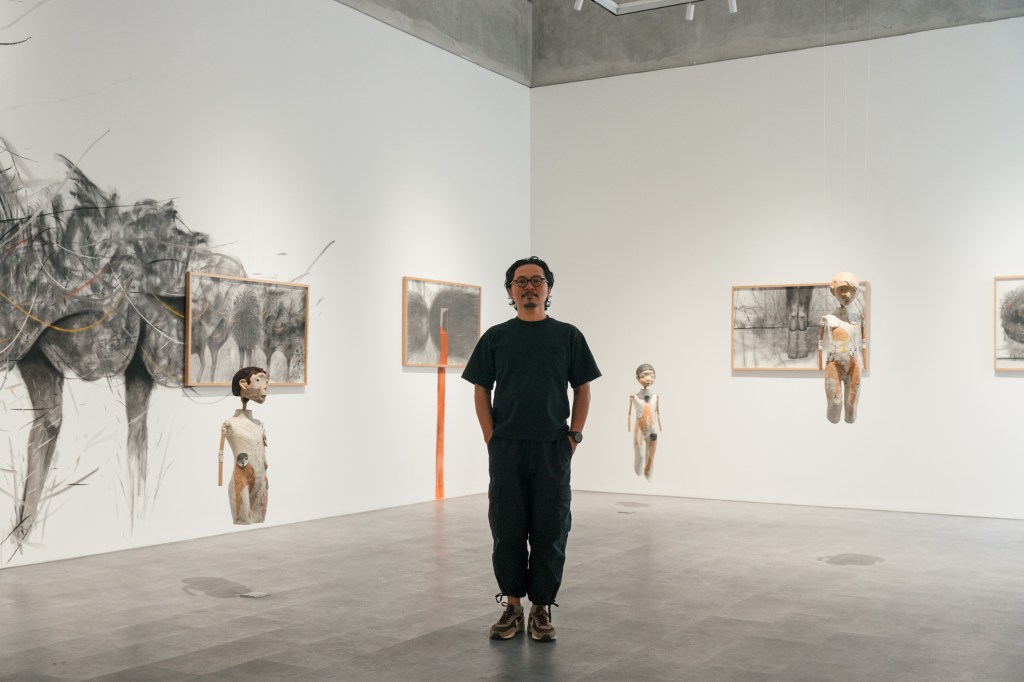
Iwan Effendi is certainly not new to the contemporary art scene. Since 2006, he and his wife, Maria Tri Sulistyani, have been involved in Papermoon Puppet Theater, a puppet-based performance art group in Yogyakarta. Iwan himself had a solo exhibition in Jakarta in 2021 with ‘Daydreaming Face’ at RUCI Art space. What Iwan and ara want to bring to Jakarta today is a repertoire of puppet theater performances without the dimensions of performance in the work of visual art frames: the event of the disappearance of the dalang. Iwan, who has worked extensively in designing puppets at Papermoon Puppet Theater, presents images of puppets that are not moving or have moved in the memory of the material present.
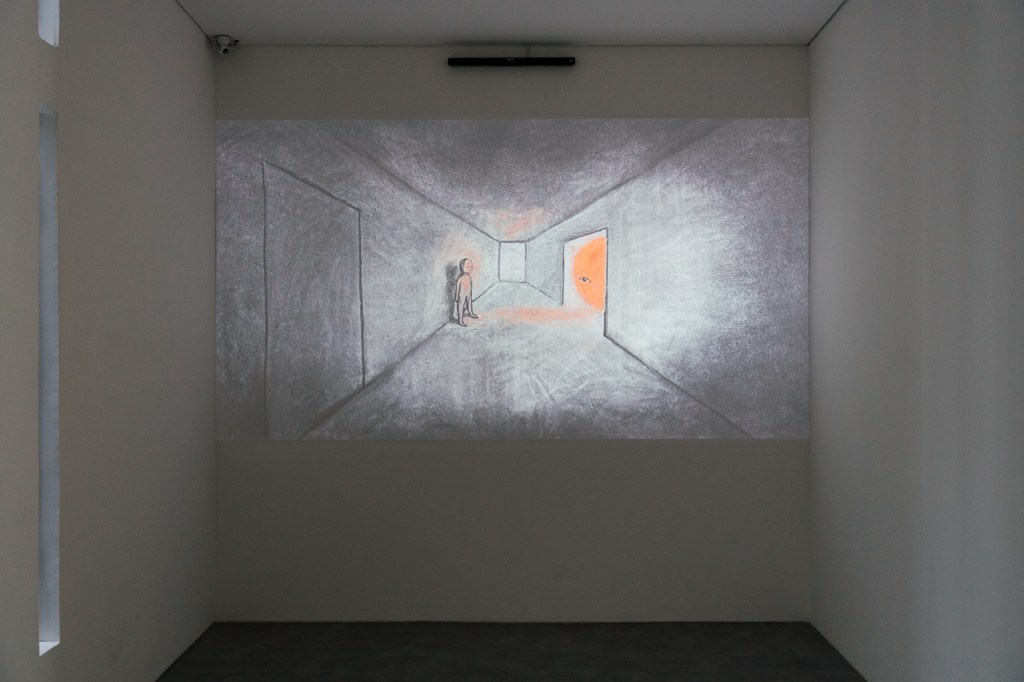
Fig’s spatial layout breaks the pace of the exhibition into two halves, upstairs (Exhibition Room) and downstairs (Focus Room). Examining the curatorial notes of Once Was, what ara tries to achieve is to discuss the transformation dimension of playing puppet theater at the level of ‘past actions’ that leave an opaque trace. In other words, from the disappearance of the puppeteer from the audience’s mind to the stage, Iwan also finds a remnant of motion through the use of visual language: the grayish smudge of an erased charcoal drawing. The first floor more tightly parses this framework by presenting a stop-motion video rather than the many drawing panels present in the space. The video titled Wanting to Hold Needing to Let Go (2025) shows a projected history rather than the grayish smudge that the viewer can only experience when looking at the 7 drawings spread across the first floor. Iwan said that he worked on the video with a count of 10 frames per second or 10 times drawing and erasing for each second to produce a video of approximately one minute seven times. In terms of topic, Iwan let go of the baggage of design or concept but refers to stimulants outside himself such as news or input from his son. We can compare the output or traces of stop motion to the visual effects in Marcel Duchamp’s Nude Descending a Staircase, No. 2 (1912) when presenting the impression of motion through the layering of visual elements. The filmic effect produced by this frame-to-frame interval is not only used by Iwan to imbue motion but also intervenes in the paper material on which he draws with a visual effect of grayish smudge as a memory of motion that states, precisely, the puppeteer’s abandonment.
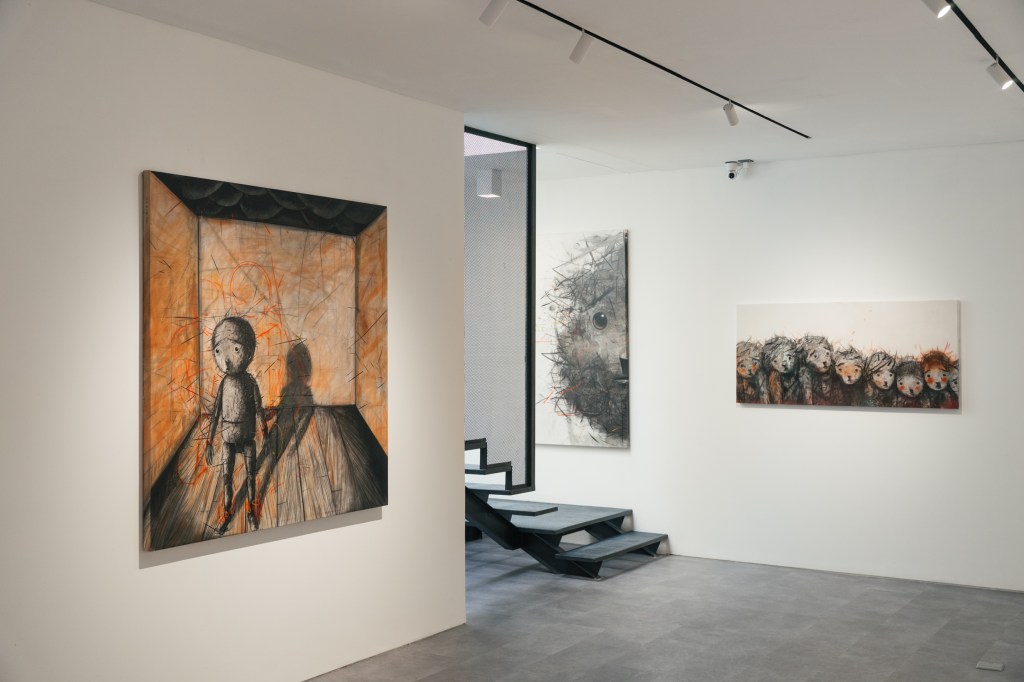
The lower floor of the ara contemporary exhibition space, named as Focus Room, releases the intensity of the frame to other matters that Iwan also wants to carry. Such as the history of the 1965 Genocide, which Iwan does not dissect through historical concepts but experiences told through Contact point (2025, 7 series of drawings). Iwan said that this work departed from the ‘homework’ of young people who were practicing at Papermoon Puppet Theater to ask families in their hometowns about what happened from this period. Here, I assume, Iwan’s visual experimentation is a little out of touch with the ‘face’ motif that intersects with his performance art. More specifically, the ‘face motif’ I refer to is the two small eyes he frames as the ‘face of the seagrass’. He found this face to be the most appropriate in presenting the events of the puppet theater because it gives the puppeteer more freedom to build emotions through movement because it works with the concept of ‘non-verbal performance’. The appearance of this face in the contact point series seems to stop at an illustrative representation of Iwan’s visual repertoire in other situations instead of reaching out imaginatively. The intersection of daydream, contact point gestures and Once Was’s curation does not reach the specificity of the vehicle spoken of emphatically on the first floor or the presence of puppets without puppeteers hanging on both floors.

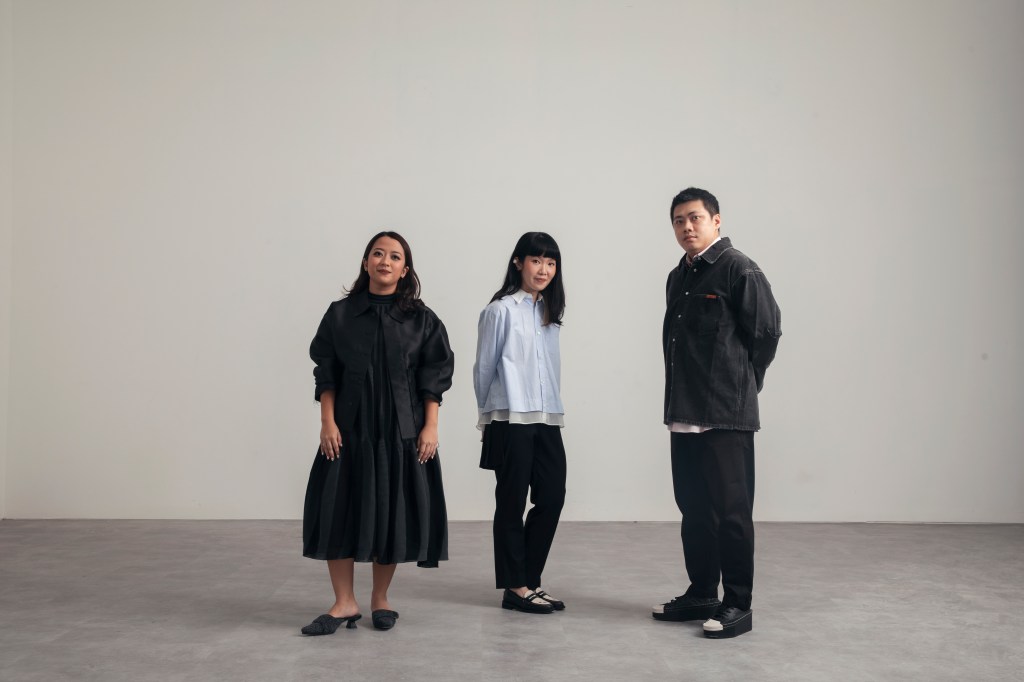
The decision to exhibit issues of memory and trajectory from artists who explore interdisciplinarity ultimately reflects a desire to question the identity of a region. The practice of Teater Boneka Iwan brought it together with the absence of words in the Indonesian language that classify puppets for performance (puppet) and dolls for display (dolls). Megan Arlin, one of the founders of ara, said that the findings from the artistic practice about this area are what she and Fredy Chandra and Fiesta Ramadanti, ara’s founding trio, actually want to place as the uniqueness or we can call it the identity of her gallery. The three of them, after welcoming me and my friends, began preparing for their presentation later that night to the others. In between going in and out of the interview stage, we had a little chat.
· · ·
There are three ara that occupy all times: the ara that always exists between conversations over cigarettes while they work in outside galleries, the ara that now rents a former boarding house space on Jl. Tulodong, and the ara as a framework that is planned and nurtured from exhibition to exhibition. Ten years of working in various cultural spaces and activities has put ara’s founding trio in a state of embeddedness in the local and global art world. This embeddedness can be seen as a charcoal smudge on Iwan Effendi’s paper, a mark that governs the construction of ara’s decision to, for example, frame Southeast Asia. ‘We believe in what we understand, if you try to narrow down what your expertise is,’ says Danti when reflecting on the region. ‘Southeast Asia becomes a tool for us to communicate with a global audience and we start with what we understand best,’ adds Megan. This means that within ara itself there is a history that co-exists on the surface of this new space but is invisible in today’s position.
What built the three founders’ ara was the ethos of discussion. Conversation over cigarettes transformed into an ethos of working in deep and guided discussions with artists, even two years before the first brick was laid in their current gallery. Megan explains that what ara sees in the artists’ work is the way they form an understanding of the research or the artist’s way of thinking and positioning. Of course, the relationship between a kind of regional cartographic work is also supported by their traces in the Pre-ara period, which not only emerges through speech but also the foundation of a relationship that has been established with the ethos of discussion. We cannot compare it with, for example, other trios who are also just starting out without the smudges of movement that we rarely reflect on. In the context of ara’s collaborative or curative work, the ethos of discussion also only emerges with existing relationships as Danti comments ‘Of course we want to also work institutionally but for now we will do what we can’. Thus, ara also talks about the traces of 10 years of contemporary art that are re-presented in this space.
Perumusan ‘Kerangka ara’ oleh trio pendiri masih terlalu dini untuk duji ada atau tidaknya. Melalui Once Was dan We Begin with Everything, ara baru menyentuh sedikit persoalan ‘menjadi Asia Tenggara’ ataupun memahami Asia Tenggara lewat strategi berpameran yang bertumpu pada temuan artistik oleh seniman. Sebagai ruang pamer, ara perlu bertindak sebagai perantara dari wicara wacana antar seniman dan publik yang kini mengingat proposal mendasar yang mengawali kehadiran ara. Beberapa agenda yang terencana atau terucap selama bincang kami nampaknya ingin melanjutkan kerangka tersebut dengan memperluasnya pada definisi lebih lentur tentang ‘keasiatenggaraan’ lewat Carmen Ceniga Prado, seniman spanyol yang (dalam bacaan ara) terpengaruh oleh praktik di Asia Tenggara. Lebih jauh, pemisahan antara ‘exhibition room’ dan ‘focus room’ juga akan dipertegas dengan mengadakan dua peristiwa seni berbeda secara simultan dibawah atap galeri. Dari begitu terencananya kinerja galeri baru ini, terdapat penegasan bahwa jejak-jejak bekerja pra-ara turut mengambil bagian dalam cita-cita mereka esok. Suatu ruang baru dari wicara di antara rokok baru yang membayangkan bahwa kerang ara benar-benar ada dan dapat diwujudkan.

Final year art management student at ISI Yogyakarta. Often involved in various film festivals in Indonesia. Focuses on film and fine arts.


 URAKAN