Rifki Akbar Pratama· 30.01.26 · Review
Bahasa Indonesia
Orbital Dago Bandung
13-18 January 2026
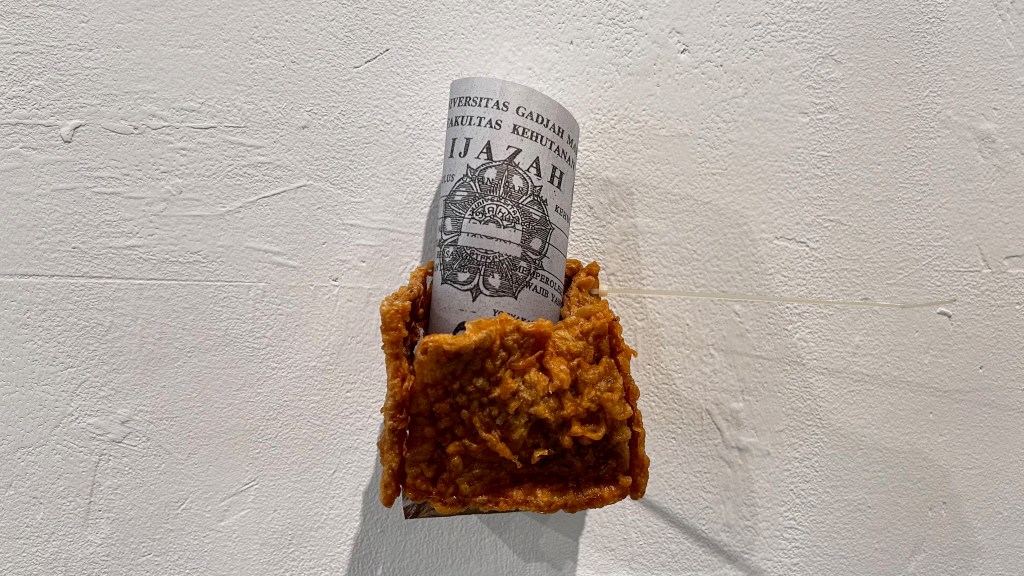
Five pieces of fried tempeh—real tempeh, not replicas—are affixed to one another, forming an open cube, mounted on the wall with the support of a square wooden beam. At its center sits a rolled photocopy of a university diploma, very likely fake, bearing a photograph and the words “Universitas Gadjah Mada, Faculty of Forestry,” with a faintly printed name: Joko Widodo. The direction of the mockery no needs interpretation once we are asked to mix together a diploma, fried snacks, and a wooden beam. The diploma controversy that stirred public interest is merely one of many comic materials in Rage Against the Muchsin, a solo presentation by Argya Dhyaksa—an artist older than Google.
The rest—by way of a slight reworking of Sianne Ngai’s theoretization—takes the form of a prototype of what she dubbed as the aesthetic of the gimmick.1 In Rage Against the Muchsin (RATMuchsin), Argya presents this mode of aesthetic judgment through two modes of operation. First, he works excessively hard to produce something—solely to harvest attention—that succeeds only in becoming futile. Second, he works almost too lightly, assembling a number of fragments for his solo presentation—yet one that nonetheless remains worthy of being called an art exhibition. In short, Rage Against the Muchsin mimics how the gimmick operates while simultaneously acting as its specter, precisely because it functions atop futility.
When cat feces—in ceramic form—becomes the main attraction, it is clear that reading Argya’s presentation through a conventional lens would be unwise. One of the simplest approaches would be to liken RATMuchsin to the structure of the brain, including its limbic system. This, however, risks sliding too easily into performative cleverness. Reading it instead through the lens of astrology offers another approach. As a Leo, there is much that can be teased out of Argya, beyond his obsession with effervescent tablets. And for that very astrological reason, it is also time to stop this line of thought altogether and return the discussion to the work itself. Much like the sentences immediately preceding the one you are now reading, Argya’s work operates by putting futility to work.
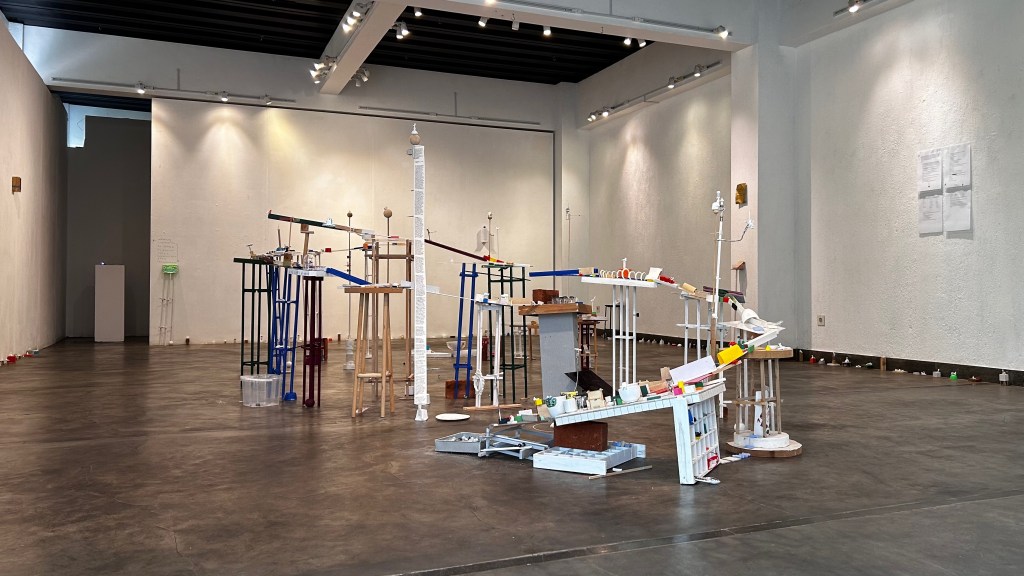
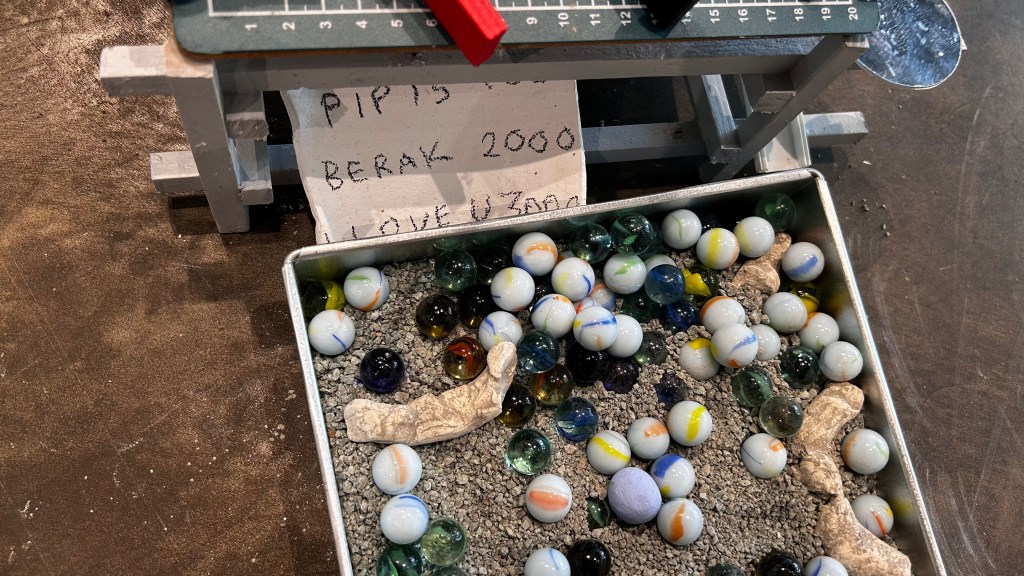
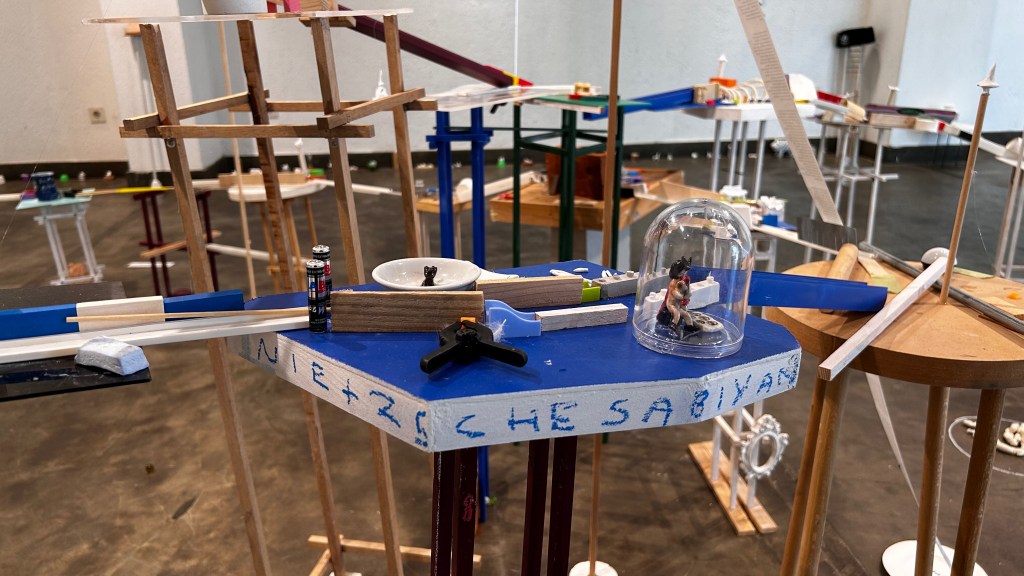
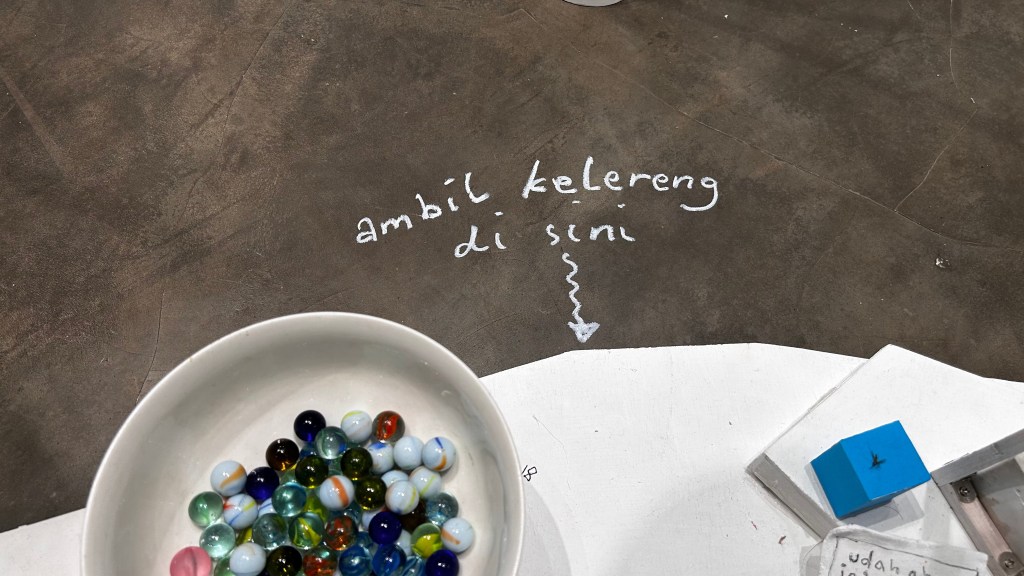
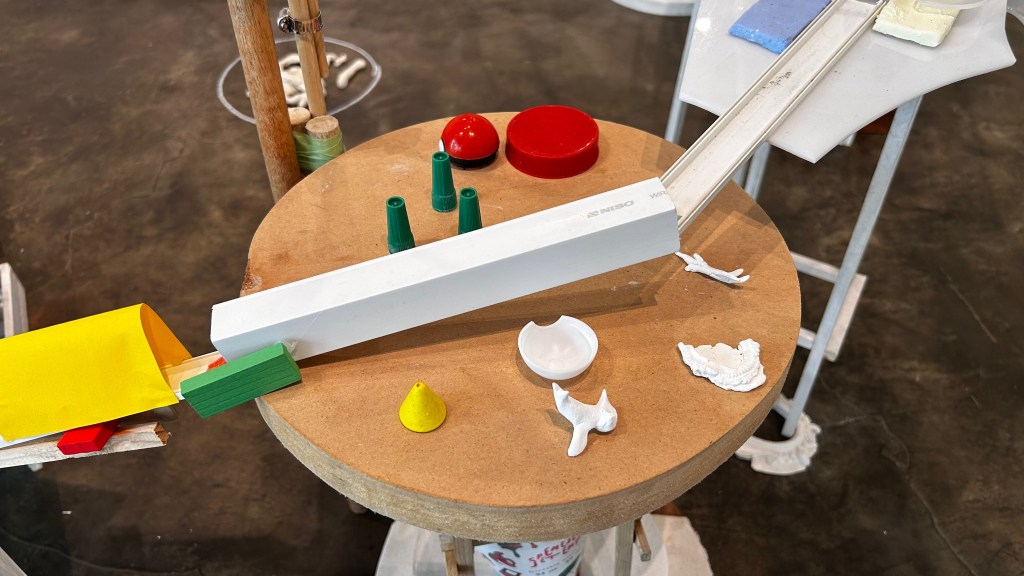
RATMuchsin is a machine for reproducing futility. Thus, to a certain degree, we can call it happiness that arises through play. This becomes evident in the “machine” placed at the center of the room. One could say that the work resembles a Rube Goldberg machine—named after the cartoonist famed for inventions that are deliberately pointless, overly complex solutions for trivial ends. In Goldberg’s case: elaborate devices to wipe one’s lips, peculiar tools for sharpening pencils, and so on. In Argya’s case: a complicated marble run that strikes a xylophone before returning the marble to its original bowl, and—along a different route—a marble chute leading into a litter box filled with cat litter and cat poop replica. Beside it a sign reading: “PISS 1000, SHIT 2000, I LOVE U 3000.” Hold your emotions in check—Argya has issued this warning from the very beginning, through a ceramic piece decorated with a Shizuka comic panel bearing the speech bubble: come on bro this is just art.
RATMuchsin is a concoction of oddity and humor that circulates online and seeps into the physical world. “This is just art” functions as a rhetorical statement about how art can—or cannot—work amid the complexities of the attention economy. While not entirely new, Argya’s method is worth noting as a way to dissect the mechanics of our attention on social media today. The central point of the absurdity he presents lies in our response to the question: What makes us divert our attention?
Through RATMuchsin, Argya writes: “In the exhibition Rage Against the Muchsin, there are several rules that are recommended to be followed at least while you are inside the exhibition space; however, these rules do not apply once you are outside the exhibition space, as everything beyond it is already beyond my authority.” This 47-word sentence appears on a sheet of paper affixed to the exhibition wall and serves as the opening to a list of Dos and Don’ts. In the Don’ts, the prohibitions range from the banal to the bizarre: kicking a pregnant woman until she falls (if it has already happened, please apologize immediately), claiming you’ve done something when you haven’t, organizing a wedding, playing Juicy Luicy songs at high volume, bringing small children (2 cm), debating Biennale Jogja until feelings of wanting to hurt one another arise, failing to feel grateful for one’s privilege, and finally, thinking to oneself, “I could do this too if it were only like this.”
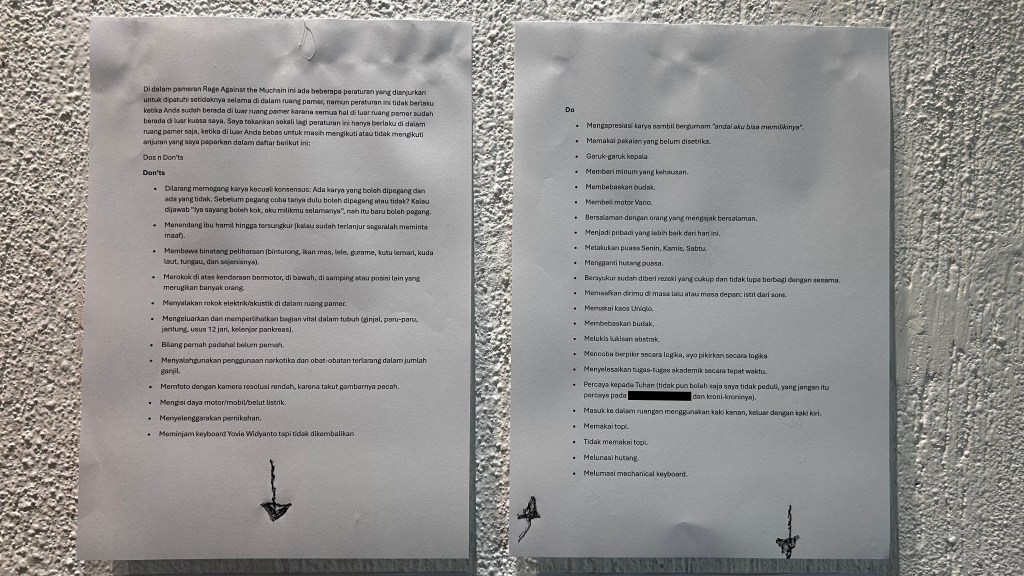
This comedic tone continues in Argya’s list of Dos: to liberate slaves, becoming a better person than yesterday, to liberate slaves, wearing Uniqlo T-shirts, trying to think logically—come on, think logically—painting abstract paintings, paying off debts, watching YouTube while eating, repeatedly traveling back in time to stop someone you love from smoking, and founding a collective even though you already know it will eventually disband and spark horizontal conflict. At this point, some readers may realize that these two extended lists function as more than mere descriptive elements. They serve as reflective material for the very question posed earlier: What makes us divert our attention?
The answers may vary, but RATMuchsin appears to enact a marketer’s maxim: “If you acknowledge that you’ll never catch up by being the same, make a list of ways you can catch up by being different.” And there it is—the very thing that redirects our attention: stark difference (or, at other times, concealed similarity, masquerading as sameness). This is precisely where the work connects to the gimmick as a capitalist form. Difference becomes a unit of exchange for the concentration of our attention. And it is there that the gimmick operates. Ngai describes it in Theory of the Gimmick as “…an aesthetic specific to a mode of production that binds value to labor and time…”
As our attention is diverted, the gimmick goes to work alongside it. We pay for something that later feels pointless with our time and attention. It is here that the key point of the aesthetic of the gimmick emerges: the moment you feel like swearing, while simultaneously setting aside the success of the gimmick in diverting your attention and making you feel as though you’ve wasted your time. To paraphrase Argya’s own joke on this matter: “I could do this too if it were only like this.”
Ngai identifies this ambivalence as a normal response when encountering the gimmick. The comment “it’s just like this” contains our judgment of the gimmick as a labor-saving trick. Indeed, Argya works almost too lightly, rather than producing technically impressive works meant to showcase expertise. At the same time, he works excessively hard, arranging ceramic fragments and clusters of found objects as currency for attention economy to work. Yet amid all this, Argya deploys a combination that holds reflective potential as a way out of the trap posed by the gimmick as an illusory aesthetic mode of capitalism itself: clusters of comedic memes.
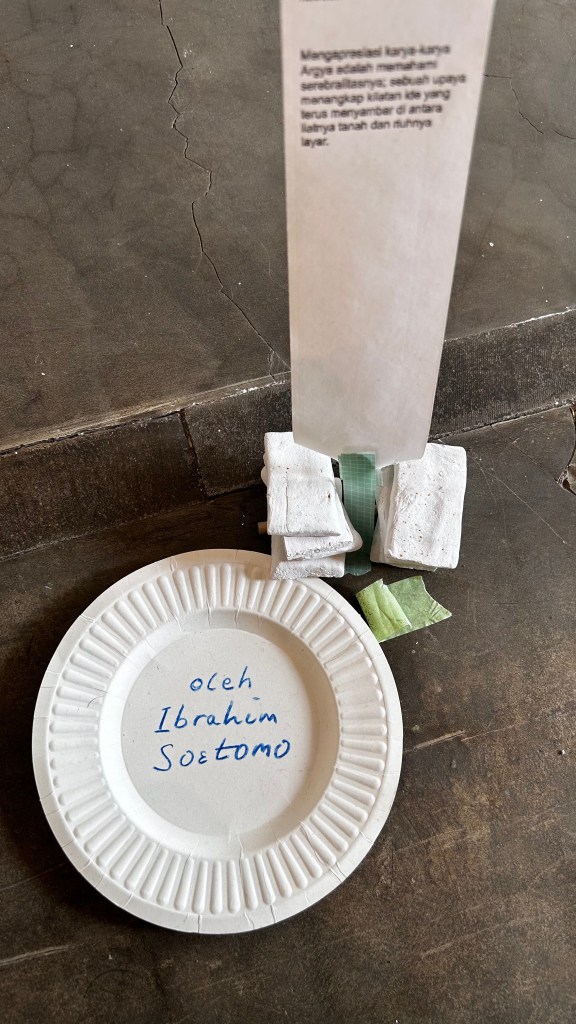
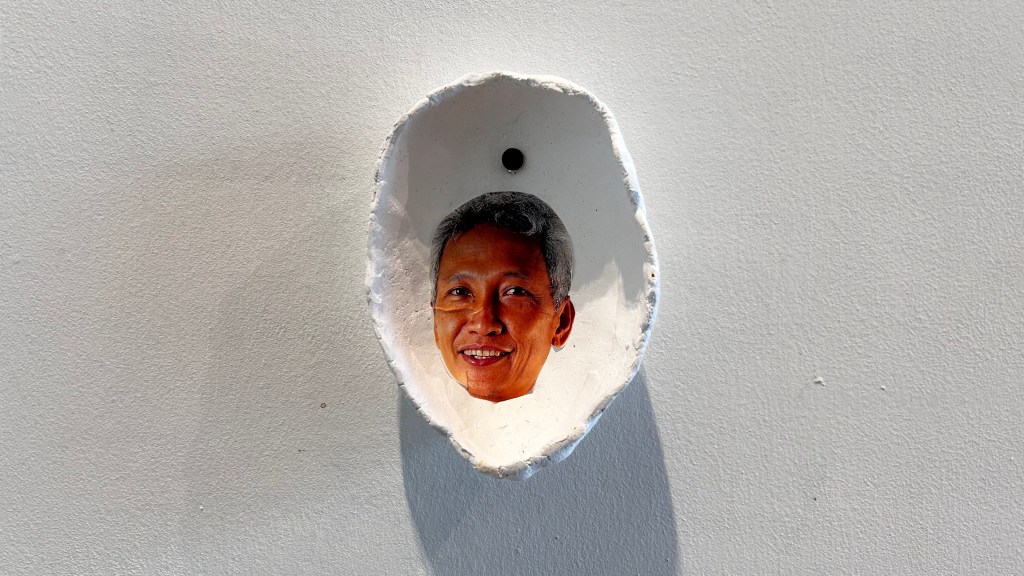
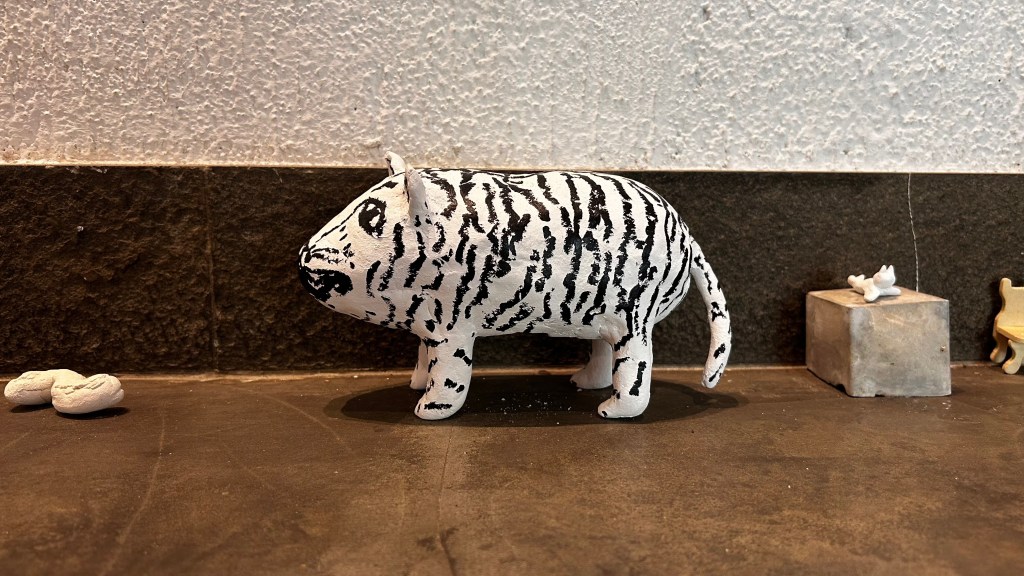
Argya makes full use of comedic memes in RATMuchsin. Some take the form of ceramemes—a portmanteau of ceramic and meme—adopting meme aesthetics within ceramic material. Examples include Sucipto the blurry shark or the Macan Putih Kediri that resembles a hippo. Others parody the works of fellow artists, such as You Promised Me Interstellar Instead I Got Ipar Adalah Maut, referencing Nurrachmat Widyasena; inversions of Adytria Negara’s The Reverse of Things series; or parodies of Agung Hujatnikajennong’s book covers transformed into Kurasa Kuaci. These references are not meant to be fully recognized, but to pass by fleetingly. At this point, the cluster of comedy itself—returning again to Ngai—still retains the gimmick’s defining trait: “giving rise to a unique set of collectively generated abstractions and peculiarly asocial kinds of sociality.”
This last point deserves attention. A key element of memes is their sociality. Yet at the same time, they prevent us from recognizing the specific element that makes them possible in the first place: the labor of their creators. In pursuit of fast and easy circulation, specificity becomes difficult to maintain. Successful memes tend to erase the names of their makers. What remains is merely a format that circulates endlessly. This is another form of labor-saving trick that drags us back into the circuits of cognitive capitalism. In RATMuchsin, this is anticipated by introducing a mode of specificity amid the expanse of futility: the politics of memory. Once again, Argya reaches this point through comedy.
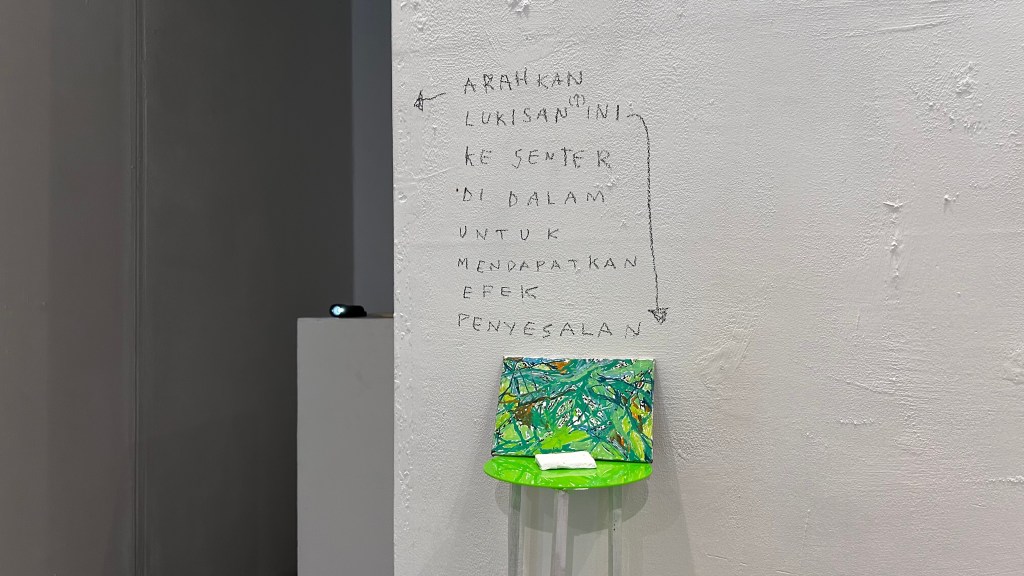
If in other works within RATMuchsin Argya still knows how to restrain himself in jest, he exceeds that restraint in one corner of Orbital Dago. A painting rests atop a pedestal. On the wall where the painting leans, a sign reads: DIRECT THIS PAINTING (?) TOWARD THE FLASHLIGHT INSIDE TO ACHIEVE THE EFFECT OF REGRET. If the instruction is followed, one finds a plate beside the illuminated flashlight bearing the words BET YOU WISH YOU HADN’T LISTENED, HUH?—that keeps invisible until one steps closer. This serves as one of the clearest affirmations that within RATMuchsin, as with the gimmick as an aesthetic experience tethered to the non-aesthetic, everything can instantly collapse into futility.
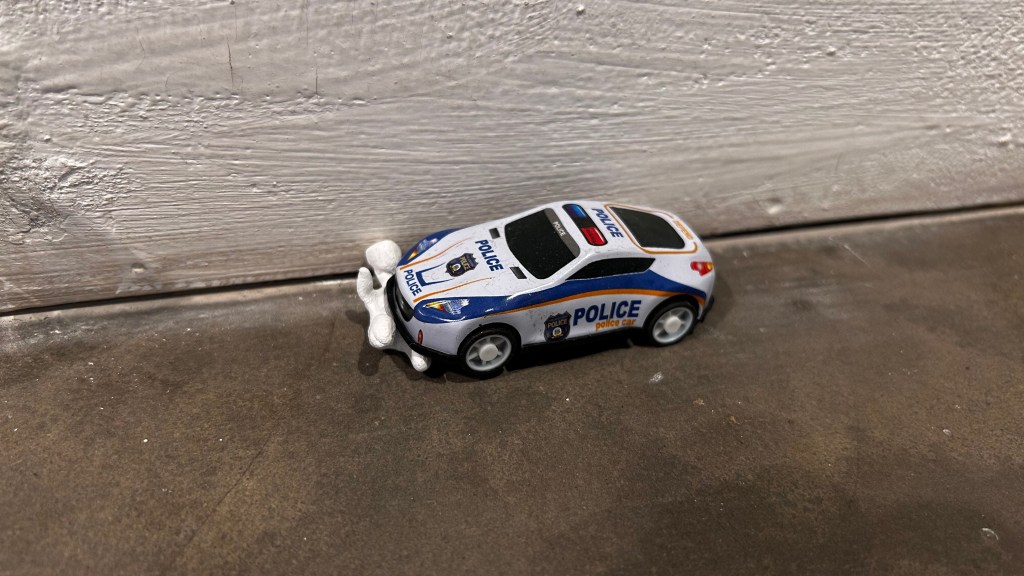
If the entirety of RATMuchsin is nothing but futility, then what matters? Amid the useless marble-run machines, photographs of Nurdian Ichsan, and a QR code for ordering fried snacks from Warung Bu Gati—easily could be despised and forgotten—we encounter one small scene with long-reaching consequences: a miniature police car running over a ceramic human figure. A fragment connected to a real event. August 28, 2025 marks the date of his death. Affan Kurniawan was not alone; at least nine others were killed as well. In the midst of RATMuchsin’s field of jokes, a pause emerges—one that transforms comedy into eulogy. A note on demands for justice that continue to be deferred. Rage Against the Muchsin may thus operate as a treatise on anger within the attention economy: a reminder that the human struggle against unjust power is, ultimately, a struggle to preserve anger against forgetting.
1 Sianne Ngai is a contemporary literary critic and cultural theorist whose work extensively examines aesthetic forms and aesthetic judgment as they operate within the social world under the grip of late capitalism. In Theory of the Gimmick: Aesthetic Judgment and Capitalist Form (Cambridge: The Belknap Press of Harvard University Press, 2020), she focuses on the gimmick as an aesthetic form characteristic of capitalism: a dubious device that works “too hard and/or too lazily,” promising savings of labor and time while simultaneously provoking doubt about its economic value. In Argya Dhyaksa’s exhibition, gimmicks are widely employed and played with. One example is the free transparent sticker—more precisely, a checkered sticker that mimics transparency like a PNG file—which works hard toward a kind of futility.

Rifki Akbar Pratama devotes himself to the confluence of history and psychology, the emotional histories of the left, intertemporal choice, and politics of affect as a researcher. Together with the Yogyakarta-based transdisciplinary research collective, KUNCI Study Forum & Collective, he dwells upon critical pedagogy, artistic practice, and knowledge production through the School of Improper Education program. His latest line of inquiry—shaped alongside Studio Malya and Reza Kutjh—engages historical memory-work through the gamified performance Yang Menyelinap Tak Mau Lesap (2025). His interest in publishing, in turn, ushered his work with Ufuk for the Jakarta Biennale 2021, where he examined the attention economy through collective, off-beat publishing.


 URAKAN