Rifki Akbar Pratama· 21.03.26 · Review
Bahasa Indonesia
Sumsum Gallery Yogyakarta
11 February – 05 March 2026
With every change of season, the skies of the West Coast are filled with hundreds of species of migratory birds. Among them is a small creature that travels thousands of kilometers each year, back and forth, as if distance were merely a matter of habit: the white-crowned sparrow. It journeys from Alaska to northern Mexico, then reverses course when spring arrives. Unlike many other species, it possesses the remarkable ability to remain awake for extraordinarily long periods.
During migration, this small body can stay airborne and awake for at least seven consecutive days. While a group of researchers took notice, the U.S. Department of Defense saw an opportunity. Without delay, they opened their wallets to fund further study. A body that does not need sleep, it turns out, was far too valuable to remain buried in the footnotes of a scientific journal. The ambition to apply such endurance to the human body—transforming the human body into that of soldiers, who remain perpetually awake—became the furthest extension of their narrow imagination.
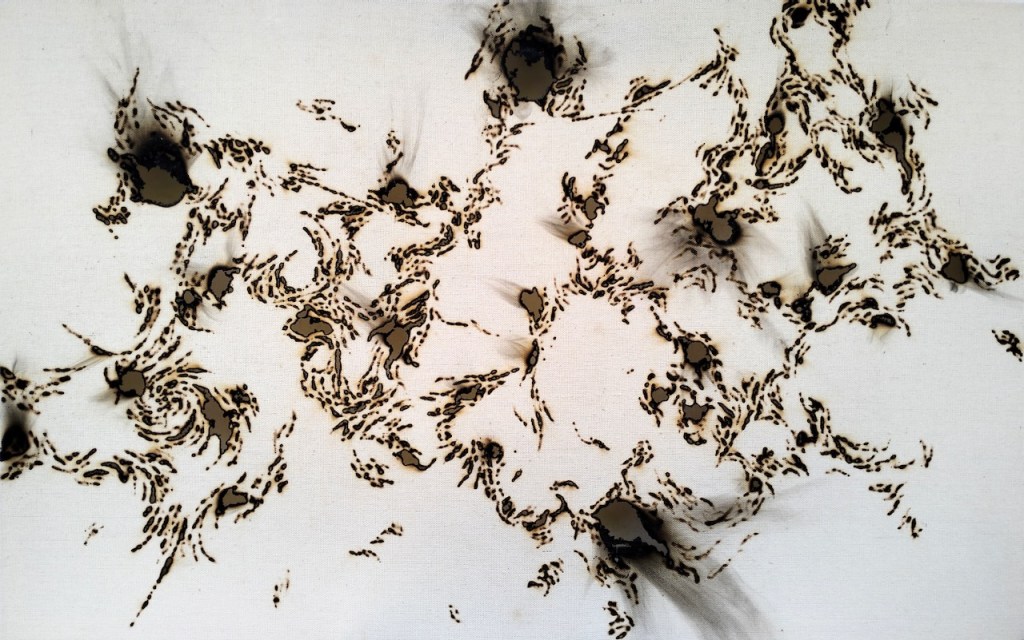
The story of the white-crowned sparrow appears in the opening pages of 24/7: Late Capitalism and the Ends of Sleep, still glowing on the screen of my phone. As the wicked idea of forcing the body beyond its biological rhythms continues to circle in my mind, I look up at Vicky Saputra’s Solstice—40 × 40 cm, sun on canvas. In the same room, on a glass window, the same word—also the title of his solo exhibition at Sumsum Gallery—appears on a poster whose corner is punctured by several burnt holes. These holes are not merely technical accidents. They signal the method that has come to define Vicky’s recent practice: solar pyrography.
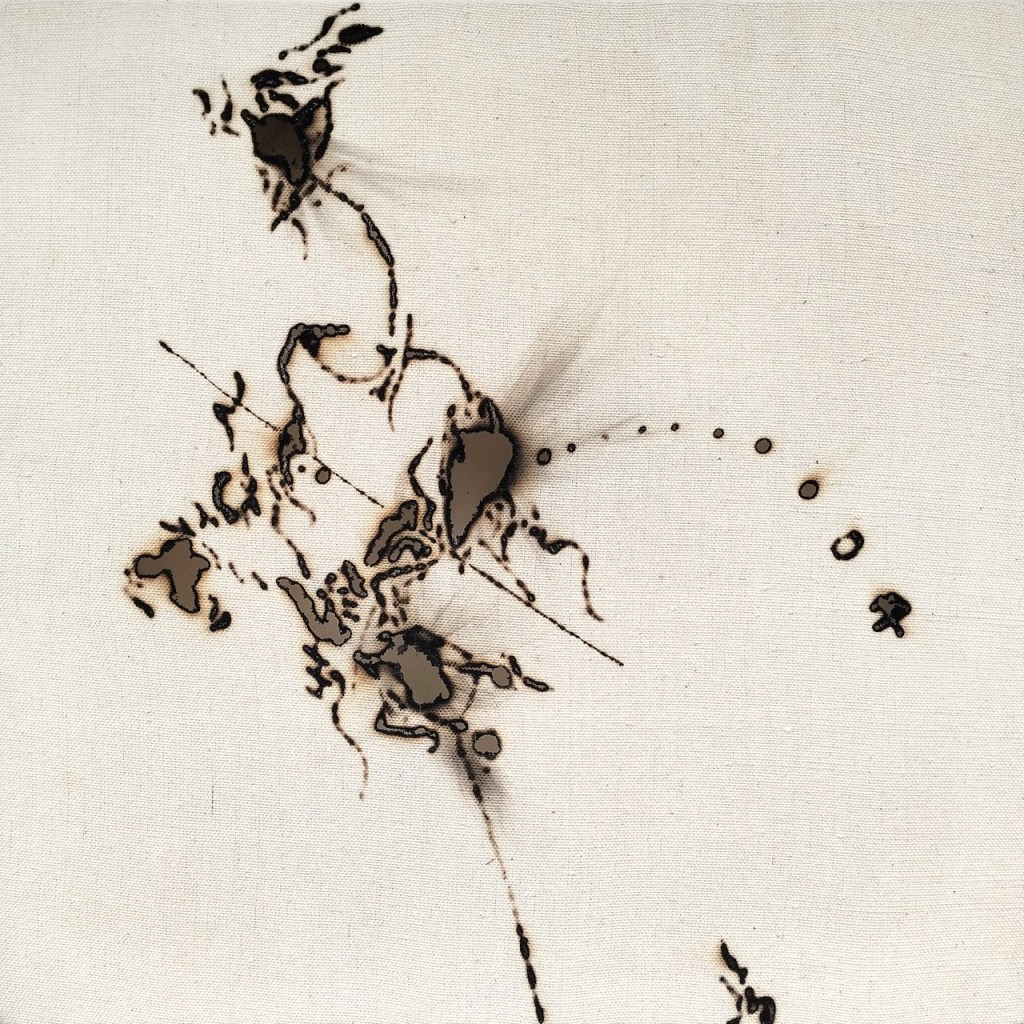
Sunlight passes through a magnifying glass, focused until it produces a point of fire used to leave marks on canvas or paper—this is the simplest way to describe how solar pyrography works. Yet such simplicity is slippery, easily trapping us in discussions of only what appears on the surface. In short, the easiest—and laziest—way to frame Vicky’s recent body of work would be to focus solely on the “traces” of sunlight etched onto canvas and paper. The non-figurative forms he produces create a field of encounter that can leave viewers transfixed, or even dazzled, by an experience that may then be enclosed within the boundaries of lyricism. As if the works in Solstice were nothing more than romantic gestures: uniquely patterned, sublime, and difficult to fathom. Such a perspective forms a dense fog that risks obscuring a crucial element of Vicky’s practice: working time under the heat of the sun.
The various marks in these works are not merely indices of refracted sunlight scorching canvas and paper, but also markers of labor—and of what enables it: labor time itself. Solstice, the turning point of the sun, may have little direct effect on workers living near the equator. Yet in other parts of the world, it marks the moment when daylight reaches its most extreme duration—the longest or shortest day of the year. In this sense, the solstice becomes a powerful allegory for Vicky’s artistic gesture in this first solo exhibition: the possibility and determination to work within a temporal span negotiated on his own terms, extending only as far as he can grasp the sun’s help.
At the summer solstice, daylight stretches as far as it possibly can. Solstice, therefore, also carries an allusion to life under capitalism, which relentlessly engineers new ways to steal time and push bodies to work a little longer—a motive extended endlessly by various means. Within the logic of 24/7 capitalism, long daylight is both a temptation and an opportunity: shift the working hours, extend the shifts a bit, manipulate the rhythms through daylight saving time—anything, as long as production continues. Against this reality, Vicky’s works in Solstice contain a valuable motif. If sunlight is the precondition for Vicky Saputra’s labor, then his recent mode of production quietly operates as a form of resistance to the faux flexibility of modern-day modes of work—at its core, simply another form of time management.
Under the shade of his studio in Bangunjiwo, Yogyakarta, Vicky’s working hours move within a quiet regularity: from 09:00 to 12:00 WIB—when the sun is strong enough to make people reluctant to look upward. Sunlight thus becomes an inherent part of Vicky’s artistic practice rather than merely the means of production. It is something that can be anticipated, but never fully controlled. Cloudy days become pauses—yet also possibilities—natural intervals inserted into Vicky’s artistic rhythm. In this sense, refraction operates not only through the magnifying glass scorching the canvas, but also through the artist’s own adaptation to the rhythm of working with the sun.
This adaptation binds nature not only as a formal presence on the canvas but also as something embedded within the practice itself. In Vicky’s hands, productivity is not solely about what labor produces—what later becomes a commodity—but about aligning the rhythm of work with the weather. Solar pyrography supports a practice that does not merely transform nature into symbol or metaphor on the canvas. Instead, it generates a form of critique grounded in practice, directed at artistic gestures that proclaim ecological awareness while simultaneously seeking to subdue nature. Here, nature is not a decorative element deployed to serve artistic desire, but something that retains its own natural character.
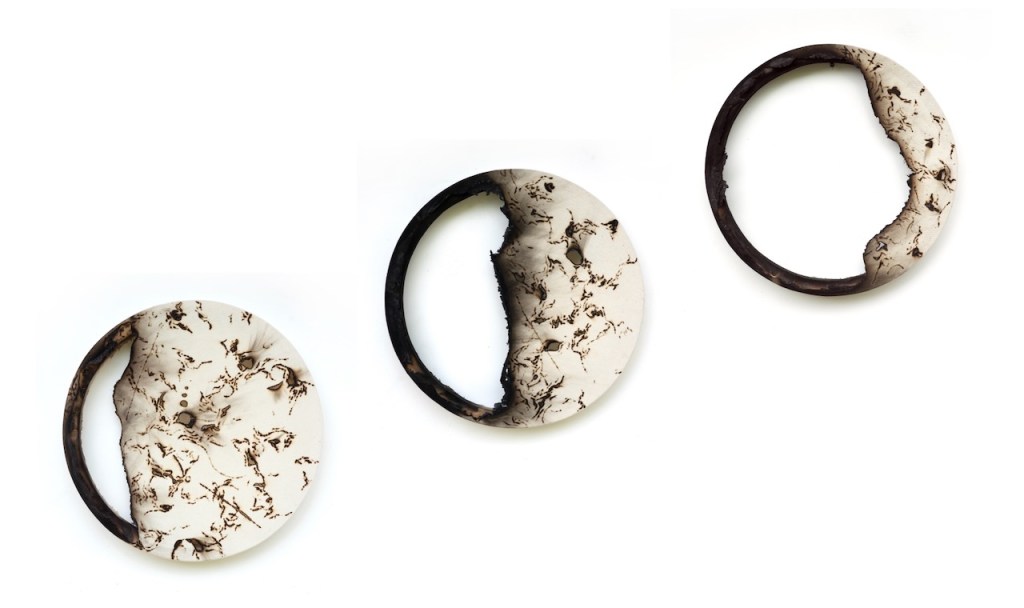
Within this natural register, twelve works—Zero Pole, Solstice, Stream, Collided, Shockwave, In Silence, The Moon Eater, Iteration, Cosmos Synthesis, Birth of Atom, Solar Flare, and Stream No. 2—all draw their titles and forms from natural references. With modest attention to timekeeping, Solstice itself becomes an index of a climatic cycle. At the same time, it points to the possibility of pauses within the obligation to keep working, for Vicky anchors his labor to something that inevitably withdraws every evening: the sun. If this possibility becomes habitual, Solstice presents an artistic practice that also serves as a stop sign, halting the process by which artworks are forced to function purely as economic commodities, since the art market cannot manipulate the refractive power of sunlight. It becomes a question mark directed at the logic of ownership that infiltrates artistic production through arbitrary commissioning demands placed upon artists.
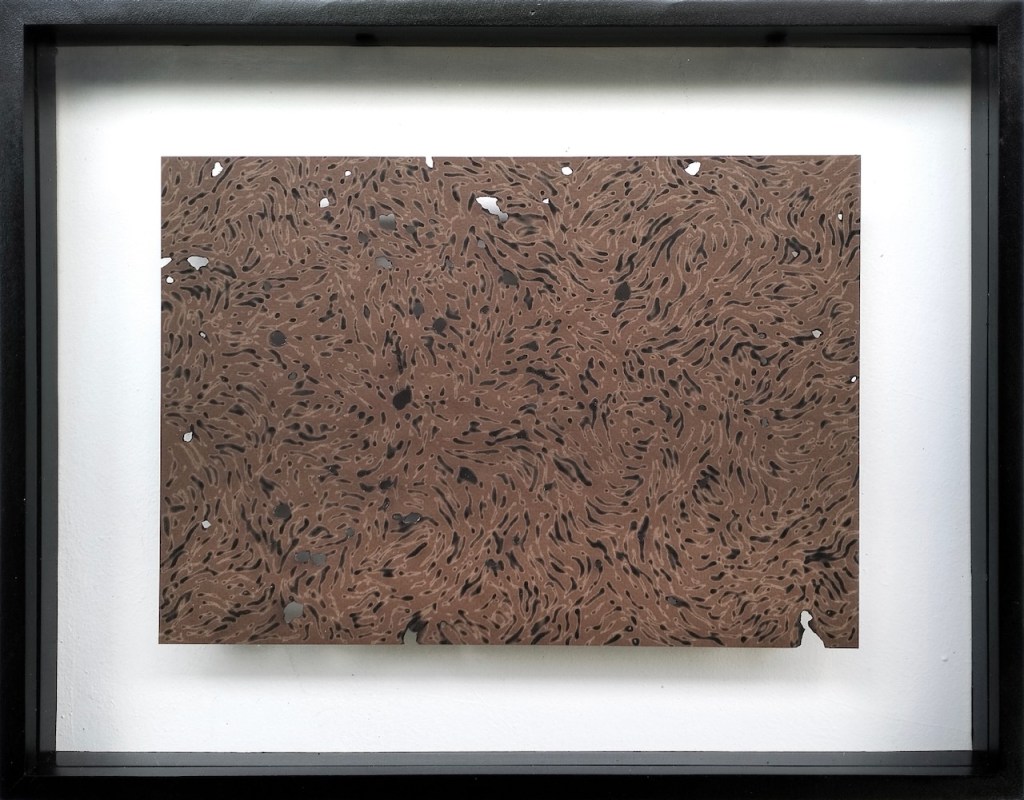
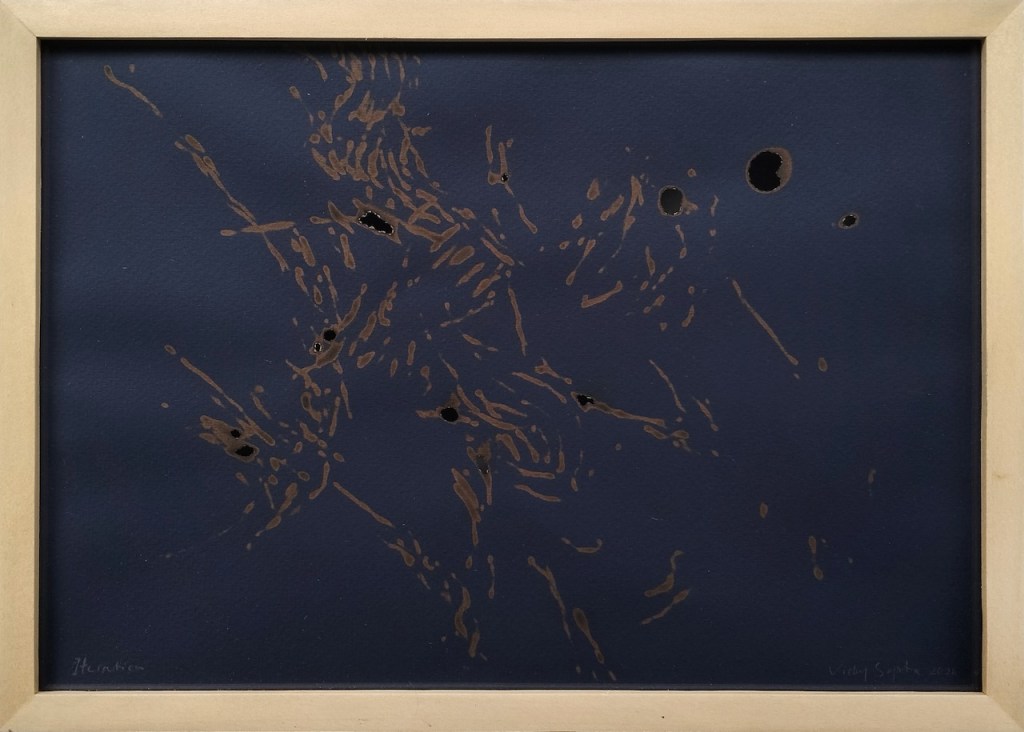
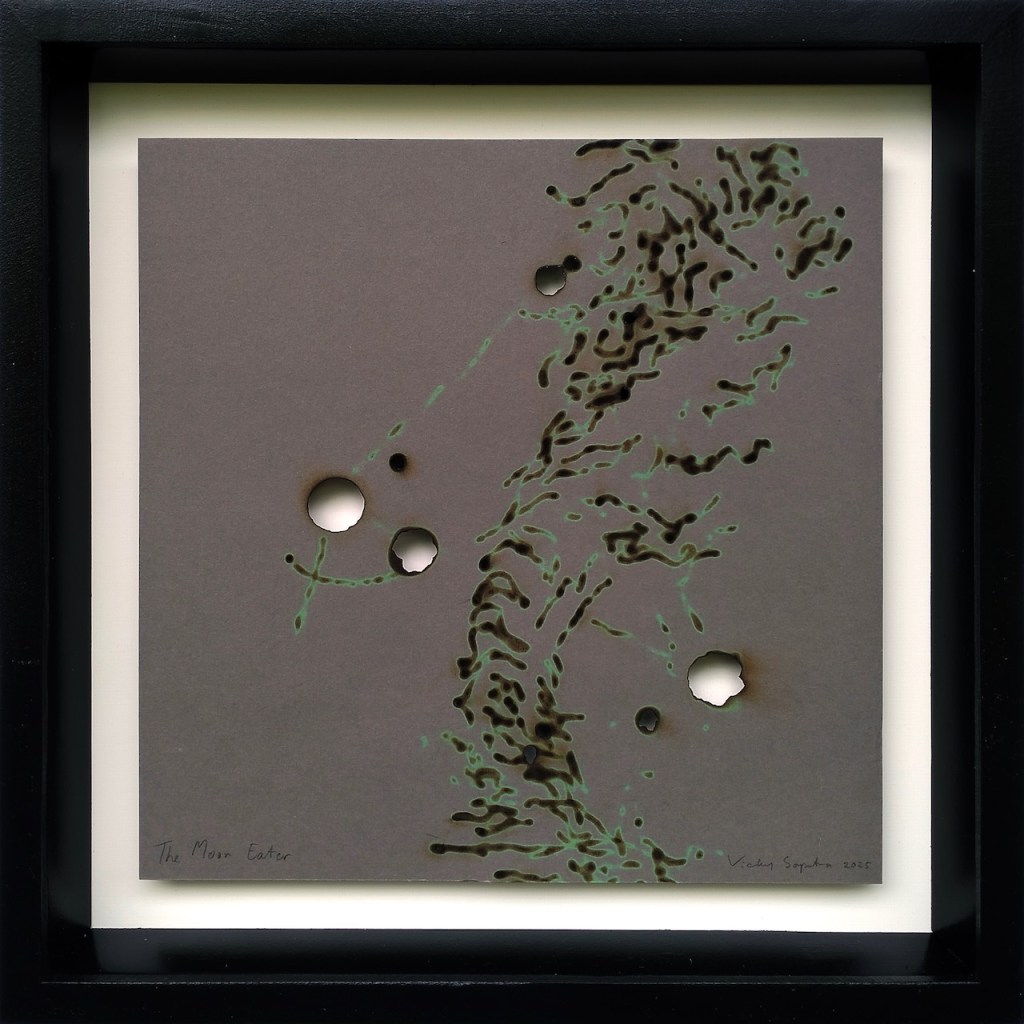
Within the universe of 24/7 capitalism, the ambition to remain awake for seven days—alongside Vicky’s three-hour diurnal routine—creates a comparison that reveals the kind of world we are building. Long pauses and extended sleep appear as errors in time management in a world that worships productivity. Yet in Solstice, pause becomes an archive of attempts to borrow fire from the sun. Pause becomes an indexical archive of bad weather, trembling hands, or labor performed under sunlight too harsh to bear. In this sense, Solstice can be read as a record of poignancy that settles upon the body, clinging to the surface of the canvas like soot. A poignancy that marks the story of living in a world that demands we work like machines, even as our bodies cannot possibly operate in the same way.
Perhaps this is another turning point hidden within Solstice: not merely the turning of the sun, but the moment we recognize that life following the rhythm of nature also embraces limits—and within those limits, a quiet resistance. As Leonard Cohen once wrote, “There is a crack in everything. That’s how the light gets in.” Behind the burnt holes in Solstice, clusters of islands of light form on the gallery wall as exhibition lighting seeps through. By shifting the canvas slightly and treating it like a photographic negative, one begins to see how Vicky’s canvases might function like photographs. Alternative modes of presentation—hanging them differently, playing with shadows—become possible. This emphasis is not purely aesthetic, but an attempt to intensify the natural element as it appears alongside the work.
This is not an arbitrary remark. It is already embedded within Vicky’s practice. The minimal use of protective coatings—he applies gesso only on the back of the canvas, leaving the face untreated—means his works may age more quickly. Over time, they will change, along with their value as commodities. Amid a culture of collecting that desires endless preservation, ephemerality and change become fundamental questions. At this point, Solstice offers a brief reflection on the circulation of artworks. It may not offer an escape from the system, but it reveals small gaps within it—spaces where the body may still choose when to bow its head, when to look upward, or when simply to stop.
On my phone, 24/7: Late Capitalism and the Ends of Sleep still contains paragraphs waiting to be read. On page 17, Jonathan Crary writes that “24/7 steadily undermines distinctions between day and night, between light and dark, and between action and repose.” Elsewhere, he notes how capitalism continually attempts to eliminate the night: notifications arrive even when our phones are in sleep mode, and time itself is polished into an endless opportunity for production or consumption. Against all this, Vicky’s practice—limited by the intensity of sunlight and the unpredictability of weather—reasserts the existence of boundaries. It becomes an honest acknowledgment that the body was not made to be ready 24/7. The ideal body is fit, not merely one that fits schedules. Such an acknowledgment, in an era when everything is promoted under the banner of flexibility, is itself a small act of dissent against the homogenization of capitalist time.Of course, this dissent ultimately depends on how far art remains entangled with the idea of turning artworks into commodities. When artistic production becomes merely a means of survival, creation emerges from obligation rather than from freedom. Without freedom, survival demands that we remain awake longer—to work, or to prepare ourselves for work. In a world that operates without pause, the ability to stay awake becomes the simplest measure of value.
Within such logic, the length of the day is no longer merely an astronomical phenomenon, but a potential measure of labor time itself. As a result, Vicky’s nights may still be haunted by reproductive labor—thinking about the next day’s production—rather than relaxing over a casual game of Monopoly Deal with his friends. If work is determined by how long we can remain awake, then the solstice—the turning point of the sun—becomes a reminder of the most heart-rending days for those whose lives remain socially mediated by work.

Rifki Akbar Pratama devotes himself to the confluence of history and psychology, the emotional histories of the left, intertemporal choice, and politics of affect as a researcher. Together with the Yogyakarta-based transdisciplinary research collective, KUNCI Study Forum & Collective, he dwells upon critical pedagogy, artistic practice, and knowledge production through the School of Improper Education program. His latest line of inquiry—shaped alongside Studio Malya and Reza Kutjh—engages historical memory-work through the gamified performance Yang Menyelinap Tak Mau Lesap (2025). His interest in publishing, in turn, ushered his work with Ufuk for the Jakarta Biennale 2021, where he examined the attention economy through collective, off-beat publishing.


 URAKAN