Rifki Akbar Pratama· 12.12.25 · Review
Bahasa Indonesia
Studio 22nya Jakarta
November 29 – December 13 2025
If you want me to pay my taxes/You’d better come over with a crucifix/You’re gonna have to nail me down
Geese, Taxes-Track 10 on Getting Killed
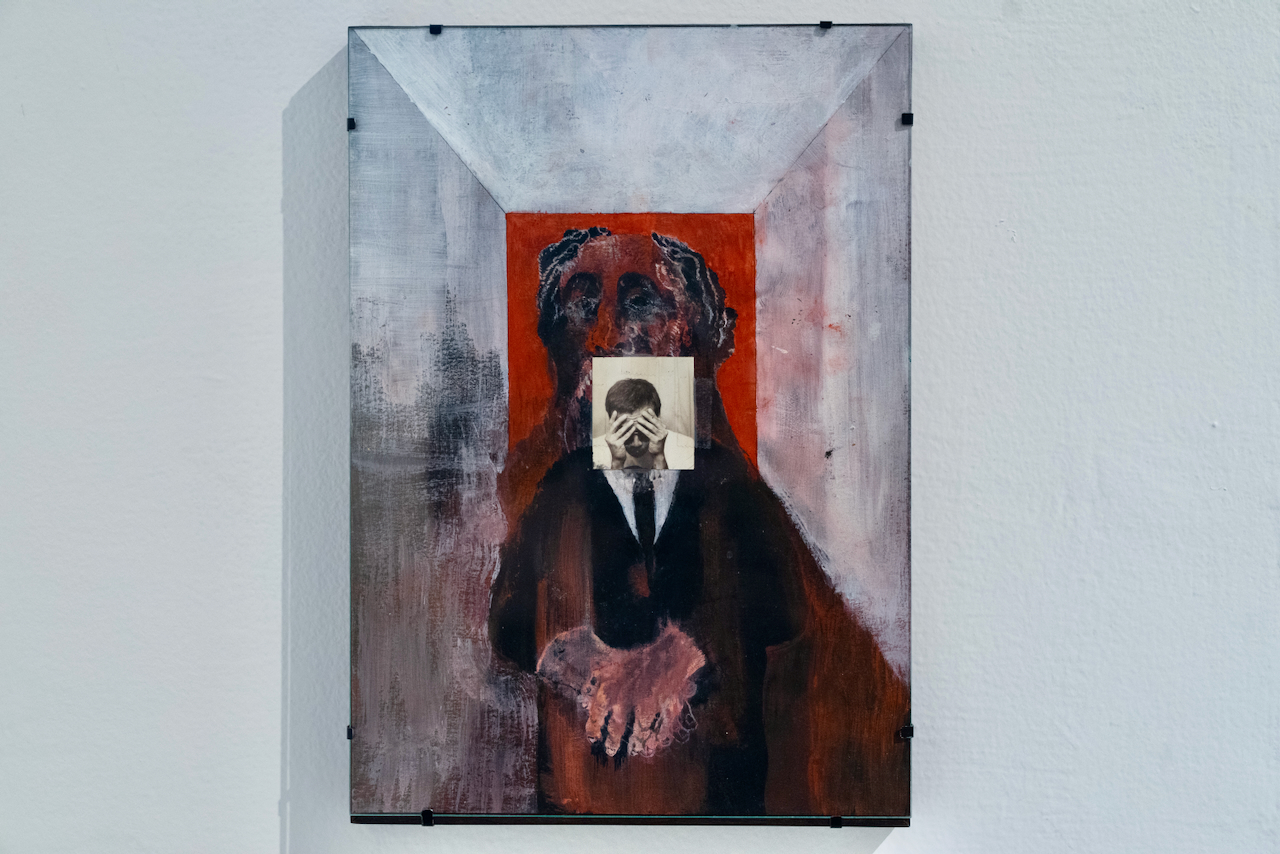
It could be before. It could be after. Either way, they’re just temporal markers. What the scene suggests is crying—a conjecture. The clue sits in a small self-portrait taped onto a watercolor-and-acrylic painting on paper: a figure bending forward, pressing the temples hard, brow furrowed, fingers covering the eyes. Behind that tiny passport-size photo, receding into a vanishing point, a similar painted figure clutches their head with a hollow stare. Below the photo, the shoulders connect to a body dressed in formal attire—so disproportionate to the small head in the photograph—wearing a tie, hands clasped one over the other. The slightly inverted perspective and the glowing window produce a sense of spatial distortion, a built-in pressure. The figure can be seen as three distinct subjects, superimposed, or as a singular subject multiplied—a kind of homunculus. It’s the minor collapse inside the major one, a concentrated disturbance set against a backdrop of larger disarray. This is La Nada (How Do I Cope) by Kareem Soenharjo, which also serves as the poster for his solo exhibition Taxing.
The weight of an affliction is what we can sense in La Nada, though not quite its emotion. The same rings true for the other works in Taxing: the feelings dispersed across the room, yet never fully cohere. Taxing, Kareem Soenharjo’s first solo exhibition, seems to embody a library of suspended feelings. We see this through his engagement with the eyes. If in La Nada the presence of the gaze appears only in passing, almost relegated to the background, in the other works, the eyes look out from everywhere. Eyes wide and dazed in Tub Triptych; eyes half–glassy with tears in Waiting In The Hospital, The Hospital Is Waiting (Triptych); eyes emerging from darkness in Self Portrait and Angeeta (Passenger Mouth); vacant eyes in Self Portrait (House); watchful eyes in Yado 1 Bathtub, Untitled (Agoraphobic Self Portrait), Surface Tension, Untitled I, and Untitled III. If the saying goes that the eyes are the windows to the soul, then in Taxing, the windows we encounter are only half open—or jammed at the hinges.

Eyes become a leitmotif in Taxing. They operate through presence and absence at once. The gaze in Taxing transforms into an abuse of the metrics of self-evaluation—one’s sense of being determined by how the social gaze demands one to appear to be, while the self slowly consents, placing interpellation at the end of the gaze. Problems arise when self-worth is recognized only under the “if and only if” conditions dictated by others’ eyes. When the ‘watchful eye’ appears, the body freezes. The body becomes a locus of suspended agency. When the gaze is static, the body does not move. People would call this zoning out. Meanwhile, it works alongside an incessant rumination over what one should do. The body halts, and the mind becomes trapped inside. At the same time, we encounter another motif in Taxing: the ways bodies inhabit space.
Everyday space and the ways bodies occupy it form another motif in Taxing. The eyes watch not only through their expressions but also through where they are situated: affixed to walls, peeking through gaps, gawking inside a mouth cavity, hiding in shadows, emerging from the floor. Their modes of presence accompany bodies whose movements are suspended and tense. Even when movement is possible, it does so in awkward gestures. Consider the staggering figure in Untitled I, put on display, or the toppled-over bodies in Untitled II.

Bodies also appear in ways that signal the sharpness of the gaze. The gaze seems piercing, the look almost punitive. Bodies appear incomplete: legs only in Surface Tension; legless in Untitled (Agoraphobic Self Portrait); lacking heads and clenched hands in Untitled III. When the gaze is absent, however, agency seems to return. To some extent, the body regains gestures: supporting itself in Untitled (Jakarta Selatan), rushing in Business Expansion, cupping the face in Self Portrait (Gardener With Water Kettle and Scissor), and in La Nada (How Do I Cope), shuffling in Untitled (In The Thick Of It), or peeking in Nuclear Evening.
Regardless of how the figures appear or are made to appear, Taxing brings forth a dense register of feelings. It suggests that everyone carries their own internal storm—always at the threshold, almost graspable by others yet never quite seized. This is palpable not only in gestures and gazes but also in how Kareem constructs interior and exterior atmospheres. Indoors, the mood feels claustrophobic and heavy. Outdoors, as in Pond, colors proliferate. Even indoors, life feels paradoxical: see how watching shadows appear in brighter tones—rendered through negative space—compared to the darkened body illuminated by darkness in Untitled (Agoraphobic Self Portrait).

The ambivalent figure can be considered a key index in Taxing as a library of suspended feelings. The figures’ affective opacity, their resistance to immediate grasp, may lead Taxing to be read as deeply personal (and thus at risk of being confined to the personal). Even so, rather than being isolated within a discourse about the self, it can also be read in relation to a longer social chain. Such passivity, borrowing Sianne Ngai’s mode of reading in Ugly Feelings (2005), can be seen as politically equivocal. It is a form of “unnervingly passive form of dissent.” In a world that demands constant functionality—ever working or being made to work—becoming dysfunctional may turn into a quiet mode of refusal.
This mode of reading can thus slightly shift Taxing’s literal domain from the emotional toward the social. At the close of a heavy year for workers, and with the planned tax increase at the start of the same year, Taxing gains another layer of resonance. Bodies attempting to care for themselves and to remain self-sufficient are continually battered by productivity norms that produce an unending sense of insufficiency. Self-care becomes merely an intermediary—a vanishing mediator, an excipient—for reproducing personal functionality (one’s ability to work or to be made to work). Much like shaving, a grooming act that becomes a source of wounding in Tub Triptych. Or the tangled flight in Business Expansion, which renders the figure trapped in a trench-like struggle across a no-man’s-land shaped by the spread of modernity.

Despite the interpretive traps posed by the selection of works—which may risk isolating the reading—Taxing successfully compresses 22 (out of possible 26) of Kareem’s works into a space that refracts intense feelings. Likewise, the juxtaposition of Self Portrait (Gardener With Water Kettle and Scissor)—supported by a branching sculptural pedestal suggesting growth—placed with its back to Self Portrait is a refreshing display strategy. If William Kentridge marks the discursive process inside his head by presenting two versions of himself in Self-Portrait as a Coffee Pot, this juxtaposition opens interpretive space for two modes of being in Taxing: chaos or deferred calm.

Such details also mark Taxing as Kareem’s first solo exhibition—still chasing, still trying to freeze both form and gesture. It poses a question for Kareem’s trajectory ahead: how his acquired skill might find a place that supports meaning-making or distinctiveness, rather than simply becoming a fixation on form itself. Consider the possibility of other ways of deploying craquelure beyond the mode used in Icarus, where it evokes a storm. Or how Kareem’s real photographic presence—affixed onto the paintings—might differentiate itself when set in tension with representational art that may be capable of producing similar experiences.
Beyond these technical matters, Taxing succeeds in bringing forth the experiences of individuals battling their own shadows (which are themselves tied to particular social structures). It is an experience saturated with a sense of uselessness—one that is always followed by the task of reframing it: that uselessness within the space of capitalist reproduction becomes usefulness for the reproduction of the self. In other words, an effort to embrace a politics of care. And it is never self-sufficient (in and of itself), for it must be connected to others, as quietly depicted in Pond and in the many small bodies of water across Taxing. That perhaps we—when more than half of our bodies are literally made of water—are no different from bodies of water. And like puddles, we cannot remain still for too long. Change is inevitable. As Sianne Ngai suggests, reflections on such suspended feelings can serve “as part of a volitional strategy that anticipates styles of nonviolent political activism to come…”. 

Rifki Akbar Pratama devotes himself to the confluence of history and psychology, the emotional histories of the left, intertemporal choice, and politics of affect as a researcher. Together with the Yogyakarta-based transdisciplinary research collective, KUNCI Study Forum & Collective, he dwells upon critical pedagogy, artistic practice, and knowledge production through the School of Improper Education program. His latest line of inquiry—shaped alongside Studio Malya and Reza Kutjh—engages historical memory-work through the gamified performance Yang Menyelinap Tak Mau Lesap (2025). His interest in publishing, in turn, ushered his work with Ufuk for the Jakarta Biennale 2021, where he examined the attention economy through collective, off-beat publishing.

