Rafael Marius · 29.03.26 · Essay
Bahasa Indonesia · Deutsch
We are once again at a crossroads of cultural events, the first quarter being more leisurely compared to the final quarter, a slack that makes the debut of Art Jakarta Papers cut a wet red mark on the annual cultural calendar. Held on 5-8 February 2026 at Pondok Indah Mall 3, Art Jakarta Papers, or Papers for short, initiates the attempt by Indonesia’s prominent art fair entity, Art Jakarta, to present only paper-based works. Papers wants to test the vitality of paper-based works while also providing a small foothold toward the full Art Jakarta on 2-4 October. Don’t worry, if you missed it, there is still an opportunity to familiarize yourself with a selection of artists from commercial galleries at Art Jakarta Garden on 3-5 May 2026. This series of events represents another corner of the art field, beside the arena of intellectual contest through art; this corner is where commercial contest in collecting practice takes place, a side that often stands opposed to the emancipatory desire of art.
If one idly compares Art Jakarta Papers with other cultural events, there will be a sense that the presence of works in great abundance is (most likely) without a stable curatorial frame. Certainly, Papers offers more clarity of approach than Garden which, reflected against Art Jakarta Garden 2025, is increasingly unburdened by the effort to expand the concept of viewing works in a garden beyond its function as a social backdrop. Even so, approaching Papers with the mindset of viewing exhibitions that speak purely about art makes it easy to point at the difficulty of finding meaning in Papers, which may actually be a lazy form of spectatorship. Papers is first and foremost motivated to examine the collectibility of art through a context that also affirms that aspect, rather than examining the sophistication of artistic language. The market is the primary pillar guiding all other questions. So for those attending Papers as an anxiously meaning-seeking exhibition viewer with no intention of acquiring anything, whether because they have not prepared the funds or do not believe in the works on show, what is left from the experience of merely observing the display case?
Art Jakarta Papers ran for four days presenting twenty-eight galleries alongside eight public programs. Most galleries are based in Jakarta with a spread across other cities such as Yogyakarta, Bandung, Bali, Surabaya, and several international galleries. They all gathered in small plots carved out across the fifth floor of Pondok Indah Mall 3. For three days, the stage area was busy with rotating conversations about paper amid the bustle of arriving visitors and gallery sitters polishing the works with words. Maximum fluorescent light radiated without being offset by any work emitting its own light, since the combination of art and technology was quite rare here, only the luminous shimmer from paper surfaces. The whole thing transformed a piece of processed plant fiber into an economic valuation, coming and going across the four days. Art Jakarta Papers is truly a defense of public interest in paper-based works, particularly in conversations about collecting that follow, wanting to occupy even its lowest corner, or what the public imagines that lowest corner to be.

Conversations About Paper
“Perhaps from these conversations we can reduce or erase the stigma of many people, or the somewhat negative perception, toward works made from paper” offered Enin Supriyanto, artistic director of Art Jakarta, opening the panel Art Jakarta Talk: Paper in the Arts Ecosystem: Collaboration Between Artists, Galleries, Archives and Collectors. That motivation did not only serve the conversation within the panel; it also drove the entirety of Art Jakarta Papers, which has more or less the same mission: erasing the stigma toward paper-based works. This stigma is difficult to swallow whole given that there is no reason to consider a work made with a cheaper base material to be worse in value than a work made with a more expensive base material. Enin’s remarks are actually situated in the domain of market valuation, or in other words, the art fair’s reading of collectors’ reluctance to collect paper works. This is reflected in the same conversation when Andonowati “Aan” from ArtSociates gallery recounted the difficulty of selling Tisna Sanjaya’s etching works in 2008 and 2018, and Andy from Galeri Ruang Dini on collectors’ worried responses regarding the fragility of paper as a material. That worrying stigma appeared, dimly surfacing in the middle of an art fair loudly talking about paper, and challenged anew through it.
A conversation with Sigit Santosa, a collector, through a panel on the same day surveyed a different horizon. His view was that, actually, there is no problem in collecting paper works that are supposedly fragile; in fact they are affordable and easy to display, while also carrying their own intimate and personal value. Paper in his discussion at the panel International Market Opportunities for Indonesian Paper Artists together with Denise Lai and Simon Tan, moderated by Adinda Yuwono, imagined paper first in the domain of the artist’s artistic choice rather than its fit with market demand. The same was conveyed by gallery managers and the artists themselves in other conversations. The matter of paper’s fragility was also resolved through care tips from Devfto, Studio Arte, and the Conservation Institute on the same stage. There is a trust that Papers wants to build. Its continuous confrontation with canvas-based works is not positioned in the realm of activism for paper as a medium; it is instead working to further complete Indonesia’s art market ecosystem, or in other words, introducing a class of product to potential enthusiasts who certainly need to be educated to feel as relaxed about paper works as Pak Sigit.
There is a contradiction we can trace. On one side, the relative cheapness and fragility of paper does suggest a subprime quality compared to works on other media. On the other side, Papers’ effort to create demand for collecting paper-based works is an effort to expand the Indonesian visual art market in general. From its material characteristics, there is an entry point for a new class of collectors coming to fill the offerings of the visual art world, a world that will continue to produce paper-based works even without demand. Although there are still works priced in the hundreds of millions, such as works by Yuichi Hirako presented by Yiri Arts, the spectrum of values allows the lowest offering to fall below one million, like the photographic work by Carleen presented by Museum of Toys priced at only 889,000 rupiah. Paper allows a work to be printed multiple times (in specific editions) or produced by tools or techniques of reproduction, so it does not always require a singular presence. All of it remains consecrated as art through the legitimizing work of the art fair event that also manages other events beyond Papers. Young collectors or even those who are not focused on collecting gain easier access to works and can become serious collectors. The effect is also not a one-time thing; it distributes keys of entry into Garden all the way to the full Art Jakarta, which will certainly contain paper-based works. The holding of Papers is a strategic maneuver to maximize commercial possibilities across any material boundary, also facilitated by the growth of Indonesia’s printmaking ecosystem, as framed by the conversation Maintaining and Expanding Printmaking Practice: The Collective Experience of Art with Krack! and Grafis Minggiran.
It is actually futile if it is not accessibility to collecting that motivates the anxiously meaning-seeking viewer to come watch the exhibition, the frugal flaneurs who have wandered into an arcade display window. The deflection of that argument is not the fault of the organizers; it is simply a direct consequence of the situation of the visual art field with its multiple perspectives. To repeat the question that opened this conversation: from the perspective of the non-collector, what might be bridged by an equal presence at the event?

A Key for the Flaneur Without a Wallet
Back on the Papers floor, suspicion from the non-collector’s point of view when watching a series of works across various booths is unavoidable. Without the interest to buy, the primary interaction gesture in an art fair, what remains is the general exhibition-viewing gesture that the organizers did not actually target (though it is possible). We can imagine that the entry ticket to Papers priced at Rp 150,000 serves as a filter for visitors who are more serious about viewing the exhibition, without denying that there are still members of the public who enter because they imagine that an arts event of Art Jakarta‘s caliber does indeed demand Rp 150,000 to enter. Because it is not free, and that is fine, the relationship between the public who do not wish to buy works and the event is bound by another fulfillment: viewing works. Here, formal criticism can actually be launched, examining the entire event on aesthetic terms, which generally ends up filling only the bottom of the cup of experience. Let us try to enact the effort of still reading this, borrowing a similar measure to a cinema-goer who has paid for a ticket, seeking a proportionate return on what has been paid.
It is certainly still enjoyable to view works by well-known artists such as Ugo Untoro, Sunaryo, or Made Wianta. Artists whose craftsmanship is foregrounded as established artists of the senior generation, canonized by various curators over decades, and who constitute the popular perception of what fine art is. Works on and with paper by these major figures of the visual arts not only display their artistic quality but are also the epitome of market taste, not always the peak of aesthetics but a settled point in the practice of collecting. Formally they can be placed on the lyrical axis or pure formal experimentation, regardless of technique, whether drawing, painting, printmaking or other technical experiments, there is a certainty that influences how we view them. It is a different matter when viewing the Old Masters who have long passed; the gaze ends in the realm of scale, we are familiar with their major works and are now viewing the minor. It must feel incomplete, when the gaze is crucified by the artist’s name, caused by a viewing situation that is difficult to make ideal.
The experience of viewing an art fair has been arranged around the interpersonal possibility between work and prospective collector as an approach that opens the opportunity for collecting. That relationship is foreign to wanderers who only wish to step into the intellectual dimension of a work without wanting to take it away, a fulfillment that happens in the phenomenon of distance from the work. The two relationships are not comparable, and are constructed so that wanderers will find themselves recognizing that the interpersonal bridge has been won. Several observations can be placed. First of all, slightly different from wandering through Art Jog which hides the commercial curtain from the wanderer’s gaze, the booths representing Papers‘ galleries radiate the sensation of entering a shop. Commerce is in plain sight and not hidden in a gallery PDF. The impression of non-space, as Marc Auge states about sites of supermodernity, thickens, composable within a designed interaction structure that prioritizes acquisitive intent. Viewing an exhibition becomes merely just browsing, almost pejorative, and can be done in any store along the floors of Pondok Indah Mall 3.
Another observation can be drawn by looking at the display approach, or more precisely the treatment of display at Papers. In general, the display approach of various galleries at Papers is adjusted to their needs, modular across a few days, works coming and going, appearing and disappearing, either sold or testing the buying power for other works. Another characteristic, not practiced by all galleries, is the sense of abundance resembling a salon display. In order to maximize the wall space of the booth they have rented, works are displayed as abundantly as possible. The galleries in corridor B apply this technique extensively, like the corridor of a morning market. The gaze ends up jumping from work to work because of the closeness between them, and on top of the crowd of visitors, only a fleeting glance can be spared for one or two works.
The effects of this kind of treatment is an emphasis on the quality of works as goods rather than commons, which becomes the point of divorce from the broader art-viewing public. Several schools of thought hold that art is knowledge on par with the concept of the commons, or for the public, or belonging to everyone. Knowledge at the ideal level is freely accessible to anyone, after several hundred years of art being released from ritualistic institutions, the emergence of thinking about its disinterested quality or its view as part of social movements. This quality is reversed by what the market ecosystem does when measuring it as goods, merchandise, if not yet willing to see it as property. Personal ownership directly limits; everything changes within a measurable matriculation, especially and above all financially. Even when not directly noticed, these traits pulse behind the gaze of certain viewers without possessive desire, that they are witnessing the last moments before any work enters a collection and becomes subject to the collector’s discretionary presentation. Art fairs generate two feelings of uncertainty: from the public who will stop looking, and from galleries who want to sell. This is the actual divorce that makes the critique of viewership inappropriate or lazy to use as a point of criticism against certain exhibition decisions; viewers often forget that they are not only viewing a presentation of ideas (first and foremost) but also a presentation of galleries’ brokerage abilities.

Special Attention to the Galleries
So works having entered the purely economic matrix also face a retracing of memories of past presentations that once foregrounded ideas. The past of a work catches up and becomes a portrait of the punctum of where it ultimately ends. For example, the booth of Srisasanti Syndicate, which is fairly diligent in holding exhibitions in its own space at Tirtodipuran Link Yogyakarta, is accustomed to presentations quite mature in line with the needs of the white cube. Encountering Dede Cipon’s lines at the inter-gallery concourse, an area of visitor foot traffic, causes it to dim completely compared to his solo exhibition. Also the memory of how gigantic the red pillars at Cemeti were when exhibiting Enka Komariah’s work, which now appears more clinical in the ara contemporary booth. Works you may have seen in their prime situation have been matriculated into a singular object, no longer confident in the idea, but affirming the existence of that non-space. The space is made sufficient until the work can appear, until finally only the work dominates the field of view at the second encounter of exhibition wanderers. There is no affirmation other than through the whisper of commerce; the world is ultimately dominated by the frame, that interpersonal bridge. If the primary value of Papers is personal value, then the disappointment of watching this dimming is also personal. Being accustomed to viewing works also dims the capacity of the anxiously meaning-seeking frugal wanderer to take home meaning.
This does not mean that quality cannot be achieved. For example, the presentation of the series nggak nyenyak by I Gusti Ayu Kadek Murniasih from ROH Project, confidently allowing the white cube quality to emerge and giving attention to the works. Clean, direct lines standing at eye level within the clinical space, without the interference of works from other artists or from other series, actually stand out prominently when viewed from the entrance. The clinical problems of other galleries were somewhat resolved through ROH’s restraint, making it strongly indicate this as an aesthetic decision over the non-space of Papers, even as what draws the viewer is still Murniasih as a name. The opposite end belongs to Mes 56, winning the performative race in Papers by opening a Photogram production table using the Cyanotype technique amid an overflow of people. The troop of indigo-overall-wearing gallery minders always appeared to overflow, to the point that their effect intervened in the space, actually inviting people without any intention of buying to stroll in. Messiness, which is a problem in many galleries’ presentations, is a point in the Mes 56 booth that carries a more socially open space. That event came closest to the possibility of distributing knowledge in Papers to the general public, even if it was very technical in nature, and also eclipsed the works that Mes 56 was actually selling. These two examples show that the peculiar qualities of galleries in Papers can actually be managed into a value, or at least a particular characteristic of how a gallery treats the presence of paper. Commerce does not disappear, but commerce is negotiated to be present without expectation of return for a few members of the public.
This does not mean good presentation will overcome works that are not good. I think the presentation by UNSEEN Museum of Toys marks the incompatibility of cultural commodification with the nature of the pauper’s gaze. The UNSEEN silent frames photo series by Carleen Sutio Prananto, marking the lower end of the spectrum of work access for prospective collectors, is composed of everyday photographs, straightforward non-dramatic images, transformed into a spectacle. There are two layers to that transformation process: first, nine series of printed UNSEEN silent frames, each in ten editions, divided into ninety aluminum envelopes. The envelopes are displayed without knowing which photograph and which edition number from the UNSEEN silent frames series will be purchased, a blindbox practice that we encountered not long ago in the sale of merchandise. The second layer: each image has been flipped (or left flipped) in a negative tone, prompting viewers to examine the “true representation” framed by the photograph. This operation ultimately contradicts the effort stated in the work’s catalogue as “The photographs do not attempt to change or beautify their subjects, but instead present them as they are.” Does not the gamification and technological intervention make the neglected everyday seem exotic by distancing it from reality into a genuine “work of art”? Commerce has transformed the everyday into the economic, conjuring the image of a tomato soup can (or in Carleen’s case the image of an egg carton) into cultural capital that can be owned, without a hint of Warhol’s criticism that tried to read its own era more broadly.
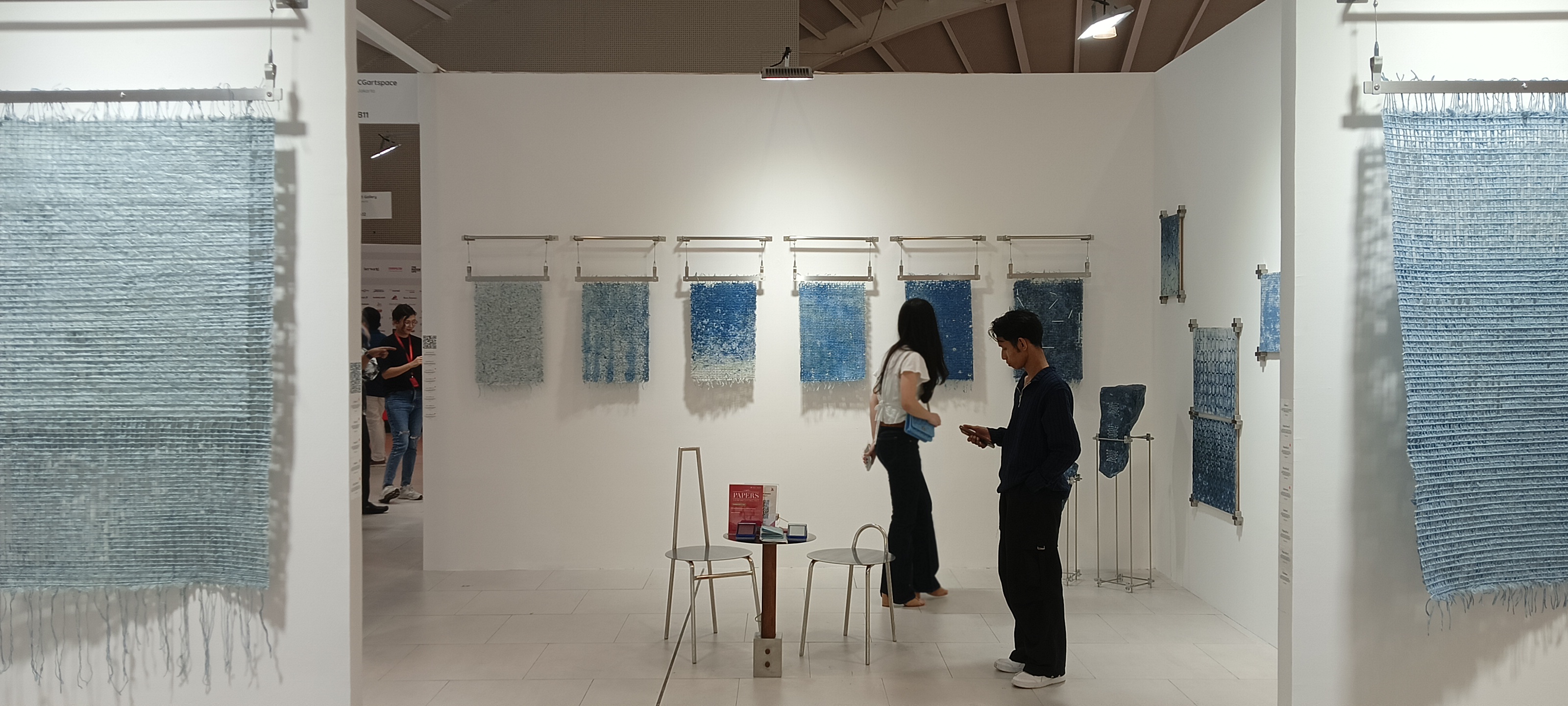
If one is looking for purity of idea, there is one booth and artist who confidently foregrounds quality beyond collectibility, even though the sold sticker on their caption states: sold. Material Relation, presented by CG Gallery, features the paper-making series by Widi Pangestu titled Indigo Through Paper and Time. This series of works departs from Widi’s residency process at Hampi Art Labs, Karnataka, South India, last year. Without going into the essence of its aesthetics, the stages of paper being produced, the mere presence of paper works (no longer paper-based but paper as material) suggests a contemplation that departs from the techne of Western art. It seeps into the everyday gesture of craft as its aesthetic axis. Fibers hang scattered, loose from threads that cross-comb and an uneven mixture of indigo. In the video clip from Widi’s residency profile at Hampi, Widi can be clearly seen damaging the surface of the paper he produces. This means every uneven texture is a deliberate decision to extract a viewing experience that is conscious of paper as a mixture, or as a processed thing. Perhaps, among all the works on paper at Papers, Widi is inhabiting the pre-paper that stands on the threshold toward the paper we all imagine: solid, clean white, potential. Through it he achieves an artistic process that dematerializes by carrying out an intensely material practice in producing, mature enough to occupy a conceptual level as a form of dismantling something that fulfills its own material needs. This handling of materiality has not yet reached the philosophical and cultural level of Aboubakar Fofana’s engagement with the nature of textiles and objects in West Africa. Indigo in Aboubakar’s study is absorbed into Bambara cosmogony related to non-human agency and how to view it through objects as something independent. Widi combines banana, abaca, and mulberry and dyes with indigo; this is a finding that goes beyond Widi’s other explorations in paper-making. Certainly Widi is not making textiles like Aboubakar, but his production approach also pursues the same territory: an object as plural conception, a critical conception. Through it the distribution of materials is mapped, independence, working with hands, and transfiguring paper no longer as a vehicle. Paper, in the CG Art booth, is an independent object, which we can read in the middle of an event that makes it a container; paper becomes an entity.

Reflection as the True Key
Art patronage, at least from the Western perspective that models various art fairs, has a history of hundreds of years, from the Medici landowners in Italy to the first President of Indonesia. Within that span, economic value is unavoidable in artistic practice, a support system that ensures artists can produce works or produce thought through works of art. Over recent decades, art practices that try to resist the market have been widespread, standing at the forefront of language and testing the possibilities of art. Thus we inhabit the contemporary era, or have even passed through it, marked by a fracturing of time that becomes simultaneous with our increasing connectedness. The art market, which drives the world economy, cannot be entirely regarded as an obsolete practice. It is at the forefront in other territories, imagining the sustainability of artists at the economic level as something unavoidable in all our lives within this ecosystem.
There is nothing surprising about the holding of Art Jakarta Papers last month; the art world is still moving and wrestling with questions of discourse and its underground conversations. The global world is also in turmoil, wars and humanitarian crises are occurring, with the Israeli-American provocation of Iran being one of them. We all certainly hope that art has an active role in speaking to the problems of the world, or at the very least, the local ones from within its space. From this unease, staring at a space where the world is shut out beyond the walls and focused on the exchange of capital is its own painful experience. When that solution is not found, it does not mean this space has failed to reach the great ideals of art that cares about the social; it is simply a matter of occupying another corner that is equally valid, while we are all still subsidized by the alcohol from the generosity of a friend whose work sold.
Formal criticism of works is perhaps less appropriately applied when reading an event that does not aim toward testing language but rather testing commerce. From that particular experiment, there is a national economic ecosystem that can actually be read, one that has gathered capital outside of the artists gathering thoughts and encounters behind it. Rifki Akbar Pratama, in the conversation among the anxiously watching viewers, offers Vishmidt’s infrastructural critique to target the accounting of labor in the staging of cultural events that adopt the style of the global north. Before that offering, which is ready to dismantle the long tradition of patronage that often is at odds with all human values, I offer a different approach that first of all imagines acknowledging that it is not the critical force of art that is at work here. This will keep us from illusory sentences that empower collected objects as if they were warheads for destroying oppression. It functions within the boundaries it has chosen, to generate profit that will then support artists who also decide to work as individual artists with their own careers.
After awareness of where the art fair departs from, an effort to play with or test it on a critical level can be undertaken. If not on the level of artistic intervention, the first thing that can be done is to walk with awareness. There is a mode of spectatorship that is silenced in this arena and that, when forced, only leads to disappointment. Real criticism can be done when seeing it as a system, which is certainly not enough by performing the activity of observation as if merely being in a space without managing to dismantle the material exchange that motivates it, and also by avoiding the exchange of signs and those large ideological characteristics.
Art Jakarta Garden will happen, as long as Indonesia or Jakarta has not collapsed, and then the full Art Jakarta will happen too. These steps will continue along the stability that the art ecosystem tries to maintain. It is inevitable as a large system before any revolution disrupts anything. To enter the future, post-money for example, the reality of today must be made peace with. 

Final year art management student at ISI Yogyakarta. Often involved in various film festivals in Indonesia. Focuses on film and fine arts.

